The Master Tolkien Left Crumbs For The Hungry

The skeptics (those forced to study his work) and the jealous (those of us who figuratively sit at his feet bashing out epic fantasy novels on our laptops) dismiss J.R.R. Tolkien as a once-in-a-lifetime genius. We couldn’t emulate him even if we wanted to (though of course we do want to). We comfort ourselves that in today’s world of instant gratification, you cannot spend several pages describing a forest, however old and steeped in magic it may be.

I have read a number of books about the master and even began a fictionalized account of his life. I have on my iPod a course from the iTunes University – The Tolkien Professor by Corey Olsen, a professor himself from Washington College.

I want to share a few tips that Tolkien had for writers. This is taken from a post by Roger Colby, an author and English teacher. Mr. Colby never met Tolkien, though thanks to photoshop, he looks like he might have! Judging by his research, he deserved to!
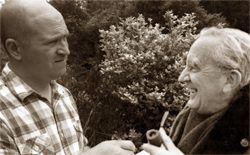
Roger Colby ‘meets’ J.R.R. Tolkien

Mr. Colby spent a month carefully dissecting The Letters of J.R.R. Tolkien, edited by Humphrey Carpenter, and underlined every instance where the master of Middle Earth wrote about his process. The quotes are attributed. Any comments belong to Mr. Colby, though I strongly recommend reading the entire article.

1.  Vanity Is Useless

Tolkien writes in a letter to Sir Stanley Unwin on 31 July 1947:

“…I certainly hope to leave behind me the whole thing [LOTR] revised and in final form, for the world to throw into the waste-paper basket.  All books come there in the end, in this world, anyway” (121).

2.  Keep a Stiff Upper Lip

In another letter to Sir Stanley Unwin dated July 21, 1946, Tolkien lists a mound of personal struggles he was facing: being ill, being overworked and missing his son Christopher who was away in the Royal Navy. He put many of his struggles aside, though, and went to writing.

He had to balance his day job with his desire to write epic stories set in Middle Earth. He found time. He made time. It took him 7 years to write The Hobbit. (117). The thing that he writes about most in this period is his struggle to get the work finished on his novels and to balance teaching and his many duties at Oxford College. Apparently he found a way.
3.  Listen to Critics

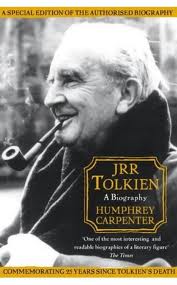
Tolkien writes to his editor about the comments C.S. Lewis made about The Lord of the Rings: “When he would say, ‘You can do better than that. Better, Tolkien, please!’ I would try. I’d sit down and write the section over and over.

That happened with the scene I think is the best in the book, the confrontation between Gandalf and his rival wizard, Saruman, in the ravaged city of Isengard.”

He writes that he “cut out some passages of light-hearted hobbit conversation which he [Lewis] found tiresome, thinking that if he did most other readers (if any) would feel the same…to tell the truth he never really like hobbits very much, least of all Merry and Pippin. But a great number of readers do, and would like more than they have got” (376).

4.  Let Your Interests Drive Your Writing

Tolkien wrote: “I began the construction of languages in early boyhood: I am primarily a scientific philologist. My interests were, and remain, largely scientific. But I was also interested in traditional tales (especially those concerning dragons); and writing (not reading) verse and metrical devices. These things began to flow together when I was an undergraduate to the despair of my tutors and near-wrecking of my career” (345).

5.  Poetry As A Road to Prose

When Tolkien couldn’t express his thoughts in prose he “wrote much of it in verse.”

He writes “The first version of the song of Strider concerning Luthien,… originally appeared in the Leeds University magazine, but the whole tale, as sketched by Aragorn, was written in a poem of great length” (346).

6.  Happy Accidents

Tolkien writes: “The Hobbit saw the light and made my connection with A. & U. by an accident.” Further: “From The Hobbit are also derived the matter of the Dwarves, Durin their prime ancestor, and Moria; and Elrond.

Mr. Colby: “Sometimes accidents happen, and sometimes those accidents will lead a writer to a publisher or create an entire novel.  Tolkien created entire worlds and then used what he knew of myth and legend to tell iconic, archetypal stories based in those magical places.

Even though he planned everything out meticulously, he still had happy accidents occur that he kept in the final manuscript because they just worked. Sometimes accidents can be blessings.”

7.  Dreams Give Us Inspiration

Tolkien writes:  “In sleep I had the dreadful dream of the ineluctable Wave, either coming out of the quiet sea, or coming in towering over the green inlands.  It still occurs occasionally, though now exorcised by writing about it.

It always ends by surrender, and I awake gasping out of the deep water. I used to draw it or write bad poems about it. When C.S. Lewis and I tossed up, and he was to write on space-travel and I on time-travel, I began an abortive book of time-travel of which the end was to be the presence of my hero in the drowning of Atlantis” (347).

8.  Real People Make Great Characters

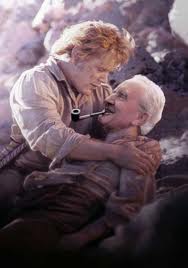
Tolkien: “There was a curious local character, an old man who used to go about sweeping gossip and weather-wisdom and such like.

To amuse my boys I named him Gaffer Gamgee, and the name became part of family lore to fix on old chaps of the kind. At that time I was beginning on The Hobbit. The choice of Gamgee was primarily directed by alliteration; but I did not invent it. It was caught out of childhood memory, as a comic word or name. It was in fact the name when I was small (in Birmingham) for ‘cotton-wool’”(348).
9.  You May Be the Next Best Selling Author

Tolkien relates the following story: “I lived for a while in a rather decayed road (aptly called Duchess) in Edgbaston, B’ham; it ran into a more decayed road called Beaufort. I mention this only because in Beaufort road was a house, occupied in its palmier days, by Mr. Shorthouse, a manufacturer of acids, of (I believe) Quaker connections.

He, a mere amateur (like myself) with no status in the literary world, suddenly produced a long book, which was queer, exciting, and debatable – or seemed so then, few now find it possible to read. It slowly took on, and eventually became a best-seller, and the subject of public discussion from the Prime Minister downwards. This was John Inglesant. Mr. Shorthouse became very queer, and very UnBrummagem not to say UnEnglish. He seemed to fancy himself as a reincarnation of some renaissance Italian, and dressed the part” (348).

10.  Books You Write May Seem Trite

Tolkien writes: “I now find The Lord of the Rings ‘good in parts”(349).

Mr, Colby: “This is to say that upon reading his books years after writing them his writing experience informs him that he is a much better writer than when he published The Hobbit.”

Tribute: Given that I have relied heavily upon the research of Mr. Colby, I would like to promote his own novel as appreciation. The Transgression Box- Roger Colby.
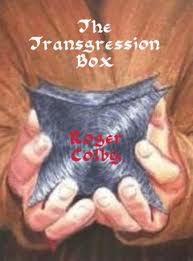
Dornin is known as the village liar…but he will also be their unwitting savior. It all begins when Dornin finds a mysterious object in the forest – a perfect cube of a box – and brings it back to his village. Unsure of its purpose, he hands over the object to the village elders – but during the night he spots a strange fog emanating from the House of Elders, and in the morning, over half of the people of the village have fallen into an unnatural and unending sleep.

Dornin decides he must set off on a quest to destroy the “Transgression Box” in order to save his people. Along the way he will encounter many strange and dangerous places, as he desperately tries to destroy that which must be destroyed for him. The Transgression Box is an allegorical science fiction tale of faith, trust and hope.

——————————————————————————————————

Alon Shalev is the author of The Accidental Activist and A Gardener’s Tale. He has written three epic fantasy novels and the first reached the Quarter Finals of the Amazon Breakthrough Novel Award as of March 2012. More on Alon Shalev at  http://www.alonshalev.com and on Twitter (@elfwriter).

What is The Future of Epic Fantasy?

I have mentioned in past posts that I am seeking to differentiate my novel from other epic fantasy series. I am being continually told by those insiders that every descent agent and publisher has five hundred manuscripts on their groaning desks about swords and quests and good .v. evil. Apparently these agents groan whenever an elf is mentioned (especially if s/he is tall, thin, loves nature etc.).

At the Berkeley Writers critique group, visitors often ask: what differentiates this from Lord of the Rings?

All this begs the question: what is the future of epic fantasy?

Is it okay to accept that there are certain conventions that are timeless? Are dwarfs small and stout, brave and ready for a rumble? Is it okay that they are miners and love to live underground?

Gimli - plenty of blades, no razor

Here are 10 basic ingredients that need to be questioned:

1) There is the good guy (or gal) and the bad one. The goods is the underdog, the bad is all-powerful, though hopefully will fall in the end.

2) Magic – the hero/heroine has something special about them that gives them a chance to win.

3) There is a teacher who mentors the hero/heroine.

4) The dwarfs are stereotypical – see above.

5) The elves are tall, beautiful, healers, wicked with the bow and arrows and…

6) Romance

7) Everything takes place in New Zealand-type environment.

8) There is a lot of walking about.

9) Swords, bows and arrows, lots of insignificant people dying.

10) Long novels, preferably in series form, with huge potential for movies.

Journeys that never end...

I have mentioned the high-concept challenge in earlier posts. The idea is to have something that is unique, that separates your fantasy novel from the rest. Enter Harry Potter and Hunger Games. 

And yet, we come back for more. A new novel from Terry Brooks or R.A Salvatore has us salivating. Christopher Paolini’s final book of the Inheritance series was eagerly awaited, and we all know when we are going to see the Hobbit movie even if we haven’t booked our summer vacations or filed our taxes.

When I mentioned the higher concept to a woman who has been reading my manuscript, she baulked. As long as there is a strong plot, a few twists, memorable characters, and a high level of writing, she said, a novel will always stand out from the rest.

The question is: Are the essential epic fantasy novel ingredients timeless? When Tolkien first created Middle Earth, did he set in motion a genre that will endure into the 21st Century?

The Master

——————————————————————————————————

Alon Shalev is the author of The Accidental Activist and A Gardener’s Tale. He has written two fantasy novels and the first has been entered into the Amazon Breakthrough Novel Award in January 2012. More on Alon Shalev at http://www.alonshalev.com/and on Twitter (@elfwriter).

Pro-logue or Against -logue

This week, I entered Wycaan Master/At the Walls of Galbrieth, the first of my Alliance series, into the San Francisco Writer’s Conference Indie Awards. In three weeks, I will submit it to the Amazon Breakthrough Novel Award.

Both competitions require the first 5,000 words of the novel and abruptly I find myself needing to make a critical decision. I have written a prologue, a short but hopefully eloquent setting of the scene.

Prologues are not always acceptable. When I presented the prologue to my writer’s group, the jury was out and, though I was not hung, neither was I acquitted.

It seems that prologues are more acceptable in the fantasy genre than others. Critiques have suggested that a prologue is there to mask a slow beginning or a lack of a hook.

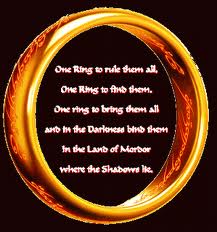
One ring to bind them all… opened the master and we were duly bound for three long volumes, cartoon series, and epic movies. Now the epic fantasy world waits with bated breath for The Hobbit movie, even though we all know what happens.

Since my novel is directed at the YA audience I made sure to begin the novel at a fast pace. I can imagine many teens skimming the prologue, though I hope they will value it in later years when they ritually return to the series as I, and many of you, return to read LOTR every few years.

So, a couple of weeks before decision time, I wish to ask:

How do you feel about a prologue for an epic fantasy novel? Does the reader want it, the agent accept it and the publisher allow it?

Your comments and advice are gratefully received. Wishing you all a happy and healthy new year.

——————————————————————————————————

Alon Shalev is the author of The Accidental Activist and A Gardener’s Tale. He has written two fantasy novels and the first will enter the Amazon Breakthrough Novel Award in January 2012. More on Alon Shalev at http://www.alonshalev.com/and on Twitter (@elfwriter).
Epic Fantasy’s Hall of Fame

Being new to the wonderful world of fantasy, I am published in political and transformation fiction, I am greatly in debt to Castle Fiction for a list of past and present masters. The comments after the names are mainly from the Castle Fiction, but I would love to hear which you have read and how you felt about them.

Past Major Fantasy Authors:

William Morris I admit that I have never heard of William Morris and understand that this is a hole in my education. I consider Tolkien to be the father of modern-day epic fantasy but apparently this is incorrect. “It all started with the publication in 1892 of the William Morris novel The Well at the World’s End. This is an outstanding piece of Epic Fantasy and it is considered to be the first epic fantasy work of the modern era. The same applies for another Morris novel titled “The Wood Beyond the World.”

Edith Nesbitt A prolific author at the end of the 19th century she created a genre of children’s fantasy literature. It often had normal contemporary children who engaged in magical adventures and discovered magical objects. She set the genre for many contemporary writers including J.K. Rowling. Some of her notable books are Five Children and It and The Story of the Amulet.

J.R.R. Tolkien A master of the craft that created the complete world of Middle Earth which included maps, languages and much more. Most notable works is the Lord of the Rings Series.

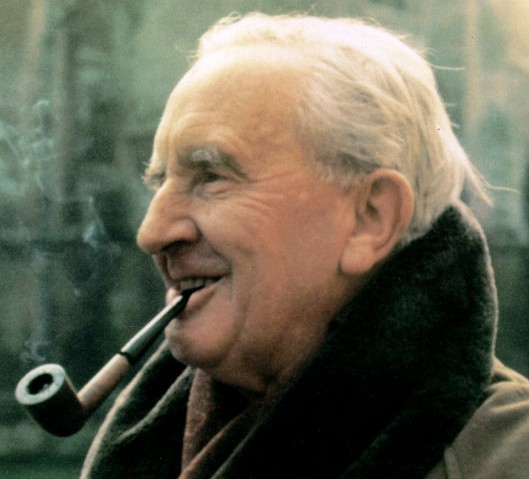
Tolkien - Middle Earth Master

Edgar Rice Burroughs Early twentieth century writer that created memorable characters and explored different worlds. His most memorable character is Tarzan. And his most popular series of books include the Barsoom series which takes place on Mars. The Venus series and the Pellucidar series which takes place within the hollow earth.

Robert E. Howard Mid 20th century writer who was a heavy contributor to the pulp fiction magazines. He is generally credited with creating the swords & sorcery genre. His most notable character is Conan.

T.H. White Mid 20th century writer who penned several books in the King Arthur tradition. The most notable of which is The Sword in the Stone which ushered in the modern Arthurian novel. Of note was a posthumous publication of his novel The Book of Merlyn

E.R.R. Eddison Considered to be the father of High Fantasy he wrote several books that influenced authors to come such as Lewis and Tolkien. Of his highly imaginative worlds The Worm Ouroboros is one of the most famous.

C.S. Lewis He was a scholar of medieval literature and mythology penning many works in a variety of genres including fiction, religious fiction and science fiction. His most notable works are the epic fantasy Chronicles of Narnia.


Present Major Authors:

Terry Brooks In the late 70’s Brooks published the novel The Sword of Shannara. It climbed to the top of best seller lists and stood there for years. Heavily drawing on Tolkien this book reintroduced the epic fantasy to the general public. Brooks continued the Shannara series with several more books. He has gone on to pen even more series.

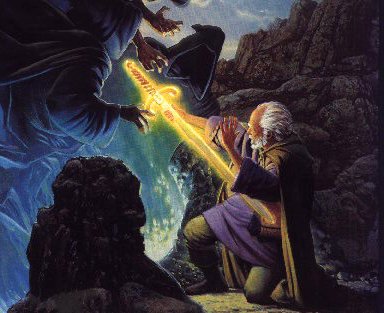
Scene from Sword of Shannara

Terry Goodkind Writer of the Sword of Truth series which began with Wizards First Rule This is a solid series that takes a more serious approach to epic fantasy. The books explore philosophical questions. The series became a TV series – Legend of the Seeker – which lasted for two seasons.

Robert Jordan Is the writer of the enormously successful Wheel of Time series which is currently eleven volumes. He has also written many works based on the Robert E. Howard Conan character.

Stephen Donaldson Creator of The Chronicles of Thomas Covenant series of books which now number seven volumes and is most notable for its use of the anti-hero in which the main character maintains a reluctance to actually take on the mantle of the hero. He has written several other series in the genre.

Marion Zimmer Bradley Editor of the famous sword and sorcery series Bradley is also a prolific writer. Most notable among her writings is the Arthurian Avalon series which begun with The Mists of Avalon.

David Eddings Writer of sword & sorcery and epic fantasy series he is most famous for the Belgariad and the Mallorean series.

Raymond Feist Many of his works are set in the connected worlds of Midkemia and Kelewan. This is called the Riftwar series and the novels range over various geographic locations and span centuries. He began his writing with the first novel in the Riftwar series called Magician: Apprentice. Another series of note is the Krondor series.

Robin Hobb Is the author of several popular trilogies including The Farseer Trilogy, The Liveship Traders Trilogy and The Tawny Man Trilogy

Stephen King Although considered to be the master of horror King has published an enormous body of work in the fantasy genre. He crosses genre at will and breaks all the rules but notable is his Dark Tower Trilogy and The Eyes of the Dragon which is classic fantasy.

L.E. Modesitt Author of several series most notable are The Corean Chronicles
Set on the world of Corus (or Acorus), where strange and dangerous beasts roam and people with magical Talent can commit astonishing feats. Also is The Spellsong Cycle and The Timegod’s World which draws heavily on Norse legend.

George R.R. Martin Most notable for his Song of Ice and Fire series which was begun with A Game of Thrones in 1996.

Tad Williams Writer of several fantasy series the most notable of which Memory, Sorrow, & Thorn which was begun with The Dragonbone Chair

J.K. Rowling Creator of the enormously popular Harry Potter series which began with Harry Potter and the Sorcerer’s Stone. These books have also been transformed into successful movies.

David Farlane – The Author of the Acclaimed Runelords series. The fifth book has just been published and the first book is being made into a major motion picture.

What are your favorite authors of High or Epic Fantasy? Do you agree with the comments added above?

——————————————————————————————————

Alon Shalev is the author of The Accidental Activist and A Gardener’s Tale. He has written two fantasy novels and the first will enter the Amazon Breakthrough Novel Award in January 2012. More on Alon Shalev at http://www.alonshalev.com/and on Twitter (#elfwriter).

When is an Elf not an Elf? And why do we care?

Yes, my novel is compelling, special, well-written etc. just like the 499 other epic fantasy manuscripts sitting in the slush piles of every publishing house that offers YA epic fantasy.

I am working with an agent who is asking the challenging and insightful questions that will help my manuscript stand out from the rest. It is tough and I am feeling very possessive. Last week I shared his prompting to seek a Higher Concept.

One of the aspects that he wants me to consider is changing my elves, who make up many of the main characters and cultural references. He suggests that I consider changing the elves for a new, mythical race that will set me apart from the rest.

Let me state from the outset that I have no doubt this man knows far more than I about the publishing world, has considerable experience and understands the current state of the publishing world.

But my elves? Our elves? Those of us who grew up on Tolkein, Paolini, Brooks and others, have standards, images, friends. Legolas and Anwen, Arya and Blodgarm, and many others have created a rich and familiar texture. We welcome them surfacing as we settle into a thick novel. We embrace them because there are common threads that pass between authors. We call it a culture, those who don’t read fantasy roll their eyes.

                               Nobel Haldir – we owe him for Helm’s Deep, no?

Terry Brooks’ children know that he is not all there, he tells us as much when he opens his book Sometimes the Magic Works: Lessons from a Writing Life. More on this book in a later blog.

But Brooks in not dissimilar to the rest of us, just considerably more talented! We pass through a gate in our imagination and reacquaint in a world that exists in a shared consciousness.

Here the elves are tall, thin, light-footed and beautiful. They are fast and posses stealth and discipline. They are in touch with the energy of the earth, the forest, the animal kingdom. They excel in archery, crafts and healing. Perhaps they are aloof, elitist, and closed to the other races, but this comes from their ancient and rich heritage. We know and love them.

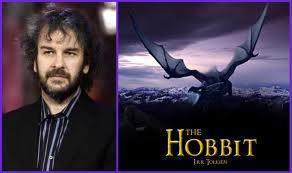
We rejoiced to learn that Peter Jackson is bringing Legalos into a prominent role in the hobbit. Well, a few raised eyebrows, since Legalos was not even referred to by name in The Hobbit when he appeared flanking his father, the King of Mirkwood.

We accept, even with a bit of jealousy that he can fight at Helms Deep for five days, or run non stop for three and still not need to brush his immaculate hair. Nor do we care that his quiver seems to replenish itself, an occupational hazard of any archer who fights battles every other day.

We don’t mind because elves epitomize something that we identify with. We all want to be beautiful, brilliant, in excellent physical condition and, of course, environmentalists. When R.A. Salvatore created Drizzt Do’Urden and the dark elves of Menzoberranzan, a giant underground drow city-state he broke new ground.

Many of us were repelled and had it not been created in the hands of a master of fantasy, we would have rebelled. It was daring, it worked and by Book Three, we were rewarded with the typical elf one finds above ground.

It is tough to turn away from the basic tenets of epic fantasy: the teacher and student, the quest, the fight against a powerful evil, dwarves, elves, dragons, a rich natural world. There is something that has entered our collective consciousness and taken root.

It is why we read and reread the masters…and it is why we will return to read those who take over the role of entertaining us in a way that only epic fantasy does.

——————————————————————————————————

Alon Shalev is the author of The Accidental Activist and A Gardener’s Tale. He has written two fantasy novels and the first will enter the Amazon Breakthrough Novel Award in January 2012. More on Alon Shalev at http://www.alonshalev.com/and on Twitter (#elfwriter).