Big Boobs and Book Covers: A Critique of Fantasy Art

When I began soliciting artists interesting in creating the covers for At The Walls Of Galbrieth and The First Decree, I asked the artists for a rendering of Mhari, an elfe (politically correct term for female elf in Odessiya) who would become the first teacher of my protagonist, Seanchai.

I explained that she was old but vibrant, tough but wise, and I waited for the examples. Every one of the four artists produced sexy, buxom female warriors. I realize that sex sells ­– I considered moving to T-Mobile because of the woman in the advert not her motorbike, helicopter or the beautiful color purple (okay I am partial to motorbikes and purple, but lets stay on topic…) ­­– but these are YA books.

Wycaan Master 1 Just Front Cover

Apparently, the use of beautiful women on covers of YA Fantasy and Sci Fi are nothing new. This article follows the noble battle by author, Jim Hines.

Hines produced a series of great photos in which he poses in similar positions to scantily-clad women on book covers. Mr. Hines wasn’t against showing some skin himself.

_65356744_scifi“The way women are portrayed is just so ridiculous, so often, you just stop seeing it,” Hines says. “I think posing has made people see it again – you see how ridiculous it is when a 38-year-old fantasy writer is doing it.”

Hines began posting his poses at the beginning of 2012 and they quickly became the most visited. This gave him the idea to create a series to raise money for research to help fight Aicardi Syndrome, a genetic disorder, and he has raised over $15,000 to date.

_65373741_fear_comp

The issue of depicting women in fantasy art in a sexual way is nothing new and, in fact, quite rampant in role playing games like D&D. Tracey Hurley, co-founder of Prismatic Art Collection, has commented: “Women are so often portrayed assuming that a stereotypical hetero male is going to be the person looking at the cover, … Male characters [are] powerful and strong, and women’s sexuality will be emphasised. And why is that a problem? It’s constraining for both men and women.”

I find this really depressing. I guess I expected something different from a genre free of stereotypical constraints because it creates its own reality. This is all the more disappointing when dealing with Young Adult literature because of the target audience. I wonder whether a scantily-dressed, thin, and cleavage-heavy woman might also be a turn-off for young women, conscious of their own body-type. Add to this that most of the women portrayed are white and I am left wondering if this explains why less teenage women read fantasy. I also think it explains the success of The Hunger Games, though the promo photos for the movie also follow the concept.

imgresIt is not enough to just thrust a sword in her hand or dress her in a chain mail bikini to project strong images of women, nor is the cover of the book enough to reinforce strong, positive female values.

While my protagonist is a male, I made sure to add strong female characters, who are indispensable to his quest. I believe I showed them as more than equal warriors, each with her own special character. I needed prodding with this, I admit, and even changed Seanchai’s teacher from a man to a woman. Interestingly, it opened up a number of exciting avenues.

Authors are powerful influencers in the community, and even more so when writing for a Young Adult market. But power comes with responsibility and we have a role to play in shaping the next generation of thinkers, leaders, and innovators.

Even though many of us write about different worlds and kingdoms, let’s help make this world a better place.

—————————————————————————————————–

Alon Shalev writes social justice-themed novels and YA epic fantasy. He swears there is a connection. His latest books include: Unwanted Heroes and At The Walls Of GalbriethThe First Decree is due out in March 2013.

Thank You for a Great Year

This is my last blog post of the year and I am sitting here feeling full of gratitude and pride. It was a year ago that I sat with my family drinking hot chocolate and mochas in a local coffee shop and we each wrote down our goals for the year. 

During the preceding week I had made the decision to spend two years seriously writing an epic fantasy series and building a platform to promote my work. I had written rough drafts of At The Walls Of Galbrieth and The First Decree, and my boys had an expectation that, as in the preceding two summer vacations, I would have a manuscript to read around the campfire in another six months. Now I was ready, for the first time, to lay out a plan.

Twelve months later and I am amazed how everything steadily came together. I feel a bubble of energy and support steadily moving me forward, and I have a lot to be thankful for.

Wycaan Master 1 Just Front CoverAt The Walls Of Galbrieth was published by Tourmaline Books in November. After a professional edit, beautiful cover and excellent formatting, both my boys and I feel immense pride as we hold the book in our hands.

The First Decree is nearing publication. The finished manuscript and equally impressive cover is in the hands of the formatters and hopefully less than two months from publication.

Elfwriter – my fantasy blog has been around for a year and has attracted a steady group of equally passionate and committed group of epic fantasy connoisseurs. I love your comments and the highest compliment is when you send a blog post on to friends.

Almost 20,000 people are following @elfwriter on twitter and the blog. Many retweet or favor a blog post. People often comment with their own experiences or when a post has touched them. I treasure these moments as we build a community together.

I want to thank the Berkeley Writer’s Group who, while most do not read fantasy, nonetheless offered each week advice and guidance. There is so much that can be said about a group who are simply meeting to support each other. I hope I was able to contribute and help them as I received their support.

The First Decree AxeA large part of my success is due to the support of a team of amazing professionals. Monica Buntin is not just an editor, she is a teacher. She will continue to explain some grammatical point until I get it (and that can require quite a bit of patience!). She has the tact and foresight to see flaws in the story and convey them in a way that will push me to correct and tighten.

William Kenney, an accomplished fantasy author in his own right, has designed two masterful book covers. How he takes the jumble of description that I send him and conveys it into a work of art that far exceeds my vision, is beyond me.

Jeny Reulo and the folks at Fast Fingers will not compromise in their commitment to create the perfectly formatted book, whether in e- or tree book format. It is a pleasure to peruse the interior design of my book.

A full circle – and my deepest thanks is to my family who suffer the author who slips into another world, where the quest to free the races of Odessiya often take precedence over the dirty dishes and the laundry whose destiny to be folded and put into drawers often takes longer than training a Wycaan elf!

Finally thank you to all who read my books and blog posts, who retweet and favor, who comment and point out mistakes, who offer guidance and advice, who are part of an extended family, enjoying the ride together.

Looking back over the past year offers a great degree of pride and satisfaction. But the best part is to turn into the wind and see the year that is before us:

* The First Decree will be released in the first third of 2013.

* Ashbar will hopefully be ready in the fall.

* Elfwriter.com will  pass its 100th blog post.

* @elfwriter will advance with 25,000 follower of epic fantasy.

The First Decree-hi resolution

Life is a journey and while we each walk our own paths, our lives are enriched when our we walk together.

To noble quests, elf bows that never miss their mark, a free Odessiya, Wycaan Masters, and most important, to good friendships around the fire, quaffing ale and smoking pipes of healthy pipe weed and telling wonderful stories.

Wishing you a year of health, happiness and friendship. Thank you for being a part of my journey.

Alon Shalev – elfwriter

——————————————————————————————————

Alon Shalev is the author of At The Walls of Galbrieth, Book 1 of The Wyccan Master series, which reached the Quarter Finals of the Amazon Breakthrough Novel Award 2012, released by Tourmaline Books. The First Decree, the sequel is due out in early 2013. Shalev is also the author of three social justice-themed novels: Unwanted Heroes, The Accidental Activist and A Gardener’s Tale. More on Alon Shalev at http://www.alon-shalev.com and on Twitter (@elfwriter).

What If Humans Were Real?

What if elves were real? There are those in the south of England who believe that elves exist. I heard this when researching for A Gardener’s Tale.  When a twitter friend shared with me that he had heard of this in the north of England, it made me wonder…

Delyphin rubbed the points of his ears as he waited for Harwin who was always late. He checked his watch. They would have to walk fast to reach the bookstore before the famous author began his reading. 

“Sorry, I’m late,” Harwin said as he jogged up.

They set off, hands in pockets. There was no point in chastising Harwin – it simply didn’t help.

“I‘m looking forward to this,” Harwin said. “I loved ‘Lady of the Earings’. The way that professor describes these mythical humans, I really begin to feel they exist.” 

I nodded, too winded to comment. The professor was a strange chap, lecturing at an elite university on ancient elven languages. They say he even invented an entire human language – as if all humans would speak the same language. Still he was a master of the epic fantasy genre.

We enter the bookstore, which is full and grab the last two seats.

Harwin leans in. “I hear he is planning on sending the humans on a new quest, that their world is threatened by some strange energy – ‘oyl’ – that is expensive, polluting and they go to war over it because there isn’t much.”

“That’s a bit of a stretch,” I say. “His humans are too smart to do that. Besides, they have the sun, the wind, and the waves of the ocean just like us. Why would they use this oyl?”

Harwin smiled. “You look rather irate. You might start believing in these humans too.”

“Don’t be daft, Harwin. That’s the beauty of epic fantasy. You get so into the story that you begin to believe the characters might actually be real. Next thing, you’ll be swearing you saw someone with round ears.”

We both laugh. That would be a sight.  The room hushes. The professor is about to speak. He opens his new book…and the world of the humans becomes real as he reads…

I can almost see their round ears and their oyl.

——————————————————————————————————

Alon Shalev is the author of At The Walls of Galbrieth, Book 1 of The Wyccan Master series, which reached the Quarter Finals of the Amazon Breakthrough Novel Award 2012, released by Tourmaline Books. The First Decree, the sequel is due out in early 2013. Shalev is also the author of three social justice-themed novels: Unwanted Heroes, The Accidental Activist and A Gardener’s Tale. More on Alon Shalev at http://www.alonshalev.com and on Twitter (@elfwriter).

Farewell My Other Son

I’m dreading the day my sons leave home. Even though they mess up the kitchen, their clothes get strewn on the floor, and they vie with me (and win) for music, TV, and that last chocolate cookie, I’m dreading seeing them walk out the door.

There is something totally scary in that you are no longer there to nurture, protect, guide, or even to bask in their glory, for their glory is their own and perhaps always was.

That is how I am feeling right now with At The Walls Of Galbrieth. This week, the internal formatting was finished and sent in, the cover joined somewhere in the publishing process, and sometime in the next few days the ebook will be published, with the paperback following in a week or two.

It is out of my hands. Like an anxious parent, I will look on, watching how many people become friends with it, how it succeeds with grades (reviews), and whether it will establish itself in the real world of fiction.

But there is nothing left for me to do, except move on to Book 2: The First Decree. As that fine Professor Tolkien once said in a little-know Hobbit novel: “Remember what Bilbo used to say: It’s a dangerous business, Frodo, going out your door. You step onto the road, and if you don’t keep your feet, there’s no knowing where you might be swept off to.”

Have a great Thanksgiving, everyone. May you spend it round a mighty table laden with food and love. But keep an eye out for a misplaced ring, a dragon on the loose, an elf who has drunk all your mead …

…or the coming of The Wycaan Masters.

——————————————————————————————————

Alon Shalev is the author of The Accidental Activist and A Gardener’s Tale. He has written three epic fantasy novels and the first, which reached the Quarter Finals of the Amazon Breakthrough Novel Award 2012, is due out in December 2012 by Tourmaline Press. More on Alon Shalev at http://www.alonshalev.com and on Twitter (@elfwriter).

I’ve Never Been In A Dwarf’s Cavern

I must confess: I’ve written almost 300,000 words of epic fantasy (three books) and never seen a dwarf’s cavern, an elf’s tree city, or a troll’s rock cairn. Now this might lose me credibility with readers, but after being complimented for my world-building by an editor at an established publishing house, I was asked from where I derive my inspiration for world-building from a fellow writer who is struggling with this important aspect.

My non-fantasy novels, The Accidental Activist and A Gardener’s Tale, were both situated in my native England, and my upcoming novel, Unwanted Heroes, is based here in San Francisco. I’m not sure if I chose these surroundings as much as absorbed what is around me into my stories. It is, I guess, what allows me to see elves in coffee shops.

I think the process is the same for me when I build my fantasy worlds. I am blessed to live surrounded by the natural beauty of California and its surrounding states, it is important to not only admire the majesty of the area but see it through the eyes of your protagonists. Three examples come to mind.

I have shared how my journey into the world of fantasy was prompted by my eldest son (then 11-years-old) complaining that I shouldn’t be writing while on vacation. I challenged him to write something with me and make it a family activity (the desperate games we play…) and there under the watchful eyes of the redwoods, we began our journey. 

It was easy to see our young heroes seeing these noble trees and the vines that hang in the forest where we were camping. They were ambushed as they passed a rock enclave, almost hidden by moss, that was a five minute bike ride from our tents.

On Monday, I will travel to an annual professional conference in St. Louis, where we have met for the past two years as well. To give us a break from the intensity of the conference, the organizers arranged a trip to a children’s museum. The incredibly creative designers had thought to fill their vast basement with caves and caverns.

While my colleagues snuck off to a nearby bar, I walked through these caverns imagining what it was like to live as a dwarf underground. I’m not sure what my biggest mistake was: missing out on a social mixer or admitting to my colleagues why I had declined their offer.

Finally, this year we traveled to Crater Lake in Oregon. Jutting out from the deep blue waters is an island called Magicians Island.  The audiovisual told us that the name came because it reminded the explorer of a wizard’s hat. I sat on the ridge overlooking the island, saw the steep grey rocks, the windswept trees, and the ospreys flying overhead.

Book 4 has a base from which to begin…

——————————————————————————————————

Alon Shalev is the author of The Accidental Activist and A Gardener’s Tale. He has written three epic fantasy novels and the first reached the Quarter Finals of the Amazon Breakthrough Novel Award as of March 2012. More on Alon Shalev at http://www.alon-shalev.com/ and on Twitter (@elfwriter).

Ever Been To The World I Invented?

How do you explain to someone how to write about a place that you made up? Or a race that has never existed? How to describe the unexplored or give directions to a destination that you have never been to?

Fantasy (and sci-fi) writers are in a unique position in the writing world. A friend of mine is writing a historical novel from the Vietnam War. It is from a time and place that she never experienced. Yet, thorough diligent research and patient interviews, she has built an authentic account of the jungles, the battles, and the actions of soldiers.

But I have to confess, and let’s just keep this between you and me; I have never met an elf, never yielded high magic or walked and breathed underwater (I tried the latter – it didn’t work). In Wycaan Master, one of my elves performed a particular feat. He will do it several times throughout the three novels and his teacher explains the rudiments to him. Nonetheless one of my dear friends from my writer’s group (not a fantasy writer) proclaimed: “elves can’t do that.” 

Our group boasts a number of very smart people, all of whom I am sure, thought what one asked. “Oh really? How many elves do you know?”

We laughed and decided that these were my elves and I could do what I want with them. It was amusing and yet, who sets the rules?

The obvious answer is that the market does, and the market is the reader. Buy a fantasy writer a couple of beers and s/he will admit that we all live in the shadow of the greats, with Tolkien being the greatest of them all.

In the pantheon upon which the great Ring Writer sits, are others held in great esteem. I am devouring Terry Brooks‘ Shannara series, and so I came across a book he wrote to explain his craft.

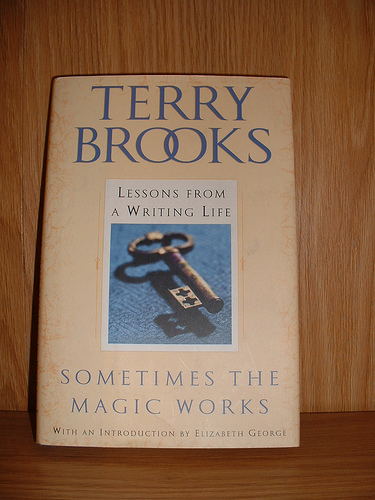
 The book is called: Sometimes The Magic Works – Lessons From A Writing Life. Brooks deals with such issues common to all who write fiction such as plot, characters, hook, dialogue etc., but he also spends time on more specialized aspects such as world creating, or even how it is different perhaps to hold the threads of a plot through a number of books or corresponding paths in a single book.

I read through Sometimes The Magic Works – Lessons From A Writing Life once, enjoying his autobiographical content as much as his craft teaching. I am going away soon for a week and plan to take the book and reread.

 I have two questions:

 1) What makes writing fantasy different from other genres in terms of craft and technique?

2) Are there other good books on writing that are specific to the fantasy genre?

Drop me a note on the blog or tweet any suggestions. I appreciate your help.

Good Writing and Reading,

Alon

——————————————————————————————————

Alon Shalev is the author of The Accidental Activist and A Gardener’s Tale. He has written two fantasy novels and the first has reached the Quarter Finals of  the Amazon Breakthrough Novel Award as of March 2012. More on Alon Shalev at http://www.alonshalev.com/and on Twitter (@elfwriter).

When is an Elf not an Elf? And why do we care?

Yes, my novel is compelling, special, well-written etc. just like the 499 other epic fantasy manuscripts sitting in the slush piles of every publishing house that offers YA epic fantasy.

I am working with an agent who is asking the challenging and insightful questions that will help my manuscript stand out from the rest. It is tough and I am feeling very possessive. Last week I shared his prompting to seek a Higher Concept.

One of the aspects that he wants me to consider is changing my elves, who make up many of the main characters and cultural references. He suggests that I consider changing the elves for a new, mythical race that will set me apart from the rest.

Let me state from the outset that I have no doubt this man knows far more than I about the publishing world, has considerable experience and understands the current state of the publishing world.

But my elves? Our elves? Those of us who grew up on Tolkein, Paolini, Brooks and others, have standards, images, friends. Legolas and Anwen, Arya and Blodgarm, and many others have created a rich and familiar texture. We welcome them surfacing as we settle into a thick novel. We embrace them because there are common threads that pass between authors. We call it a culture, those who don’t read fantasy roll their eyes.

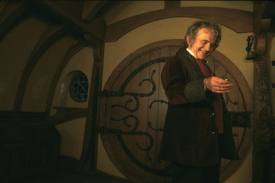
                               Nobel Haldir – we owe him for Helm’s Deep, no?

Terry Brooks’ children know that he is not all there, he tells us as much when he opens his book Sometimes the Magic Works: Lessons from a Writing Life. More on this book in a later blog.

But Brooks in not dissimilar to the rest of us, just considerably more talented! We pass through a gate in our imagination and reacquaint in a world that exists in a shared consciousness.

Here the elves are tall, thin, light-footed and beautiful. They are fast and posses stealth and discipline. They are in touch with the energy of the earth, the forest, the animal kingdom. They excel in archery, crafts and healing. Perhaps they are aloof, elitist, and closed to the other races, but this comes from their ancient and rich heritage. We know and love them.

We rejoiced to learn that Peter Jackson is bringing Legalos into a prominent role in the hobbit. Well, a few raised eyebrows, since Legalos was not even referred to by name in The Hobbit when he appeared flanking his father, the King of Mirkwood.

We accept, even with a bit of jealousy that he can fight at Helms Deep for five days, or run non stop for three and still not need to brush his immaculate hair. Nor do we care that his quiver seems to replenish itself, an occupational hazard of any archer who fights battles every other day.

We don’t mind because elves epitomize something that we identify with. We all want to be beautiful, brilliant, in excellent physical condition and, of course, environmentalists. When R.A. Salvatore created Drizzt Do’Urden and the dark elves of Menzoberranzan, a giant underground drow city-state he broke new ground.

Many of us were repelled and had it not been created in the hands of a master of fantasy, we would have rebelled. It was daring, it worked and by Book Three, we were rewarded with the typical elf one finds above ground.

It is tough to turn away from the basic tenets of epic fantasy: the teacher and student, the quest, the fight against a powerful evil, dwarves, elves, dragons, a rich natural world. There is something that has entered our collective consciousness and taken root.

It is why we read and reread the masters…and it is why we will return to read those who take over the role of entertaining us in a way that only epic fantasy does.

——————————————————————————————————

Alon Shalev is the author of The Accidental Activist and A Gardener’s Tale. He has written two fantasy novels and the first will enter the Amazon Breakthrough Novel Award in January 2012. More on Alon Shalev at http://www.alonshalev.com/and on Twitter (#elfwriter).

Seeking The Higher Concept

J.R.R. Tolkien’s Lord of the Rings set the bar. Everything since has been compared to this masterpiece. I have heard interviews with Terry Brooks and Christopher Paolini where each has had to deal with the comparisons.

Neither seemed particularly happy with the need to defend or compare their works. Each agree that Lord of the Rings (LOTR) stands on the pinnacle of fantasy and will for many years,

This leaves the rest of us wannabe fantasy authors with a dilemma. While my own Alliance series has its own specific aspects, it is inevitably compared to LOTHR. When I introduced my elves to my writer’s group, it is Legalos who comes to mind.

I've never survived a mighty battle with every hair still in place.

It is not only Tolkien of course. My antagonist is the Emperor and immediately someone compared him to Star Wars’ Palpatine, and his right hand man to Darth Vader (even without the mask and asthma).

I recently began to meet with an agent who is coaching me to prepare the first Alliance book to market. When I offered my pitch, he immediately asked what is my higher concept? He knows of Tolkien, Brooks, Salvatore and Paolini: what differentiates Shalev from these masters?

I admit to being stuck. I am reading John Locke’s How I Sold 1 Million Ebooks in 5 Months book and he admits it is much harder to change a book already written to hook your target audience than to begin a novel with the specific demands of your target audience in mind. This is doubly hard for me as I have already written two books in the series and have the third mapped out.

Every time I, or anyone helping me, have an idea, I feel resistant. I have created my world, my characters, my conflict…but I cannot explain its unique or higher concept.  Reluctant hero must learn his magic from a master and overcome the all-powerful evil dude. Sound familiar? There are many ways to make an omelet, many variations of vegetables, spices and cheeses, but all omelets involve eggs.

Need to crack a few eggs!

When someone has already used organic, cage-free, grade A eggs, how do you change the recipe? How do you find a higher concept? Any ideas?

——————————————————————————————————

Alon Shalev is the author of The Accidental Activist and A Gardener’s Tale. He has written two fantasy novels and the first will enter the Amazon Breakthrough Novel Award in January 2012. More on Alon Shalev at http://www.alonshalev.com/and on Twitter (#elfwriter).