The Fatherly Figure in Fantasy

As a warm up for reading this blog, please  say the following five times as quickly as possible: The Fatherly Figure in Fantasy.

I shared some thoughts on Left Coast Voices regarding Father’s Day this Sunday. But it occurred to me that the father figures in epic fantasy gets a tough time. Here is a brief overview of a few of our beloved characters and their fathers (I acknowledge that I am encompassing a wide definition of the genre for this post. Purists – please excuse me this once).

WARNING: There might be spoilers here, so I am giving the name of the character first and won’t be offended if you skip that part.

1. Luke Skywalker:

I know this is sci-fi and not fantasy, but we have all hung there with Luke as his father, who had just chopped off his arm, now looms over him with a lightsaber. What a time to discover your father! As if it is not enough that your uncle and aunt who brought you up were murdered, now you discover your father is a metallic mass-murderer.

Suggestion: Do not buy Dad a lightsaber. It is the first step to the Dark Side and he already has plenty of power tools he never uses.

 images

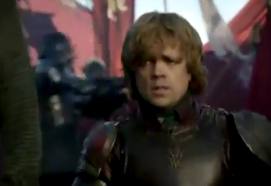
2. Tyrion Lannister:

So your father abused you and openly hated and insulted you. As if you don’t have enough to contend with two older, beautiful siblings, who are bonking, or the fact that you were born stunted and are accused of killing your mother as she gave birth to you. Not hard to understand why A Lannister Always Pays His Debts!

Suggestion: Don’t give your father a ‘quarrel’ even if he deserves it.

 images-2

 3. Eragon:

Also grew up never knowing his true father and then, like Luke Skywalker, finds his uncle, who was like a father to him, is murdered in his stead. Of course, no sooner does he discover who his father really is, than he has to bury him, and take considerable blame for brave father’s death.

Suggestion: Giving your old man your dragon/porche just before he dies is classy, but do check your insurance policy first.

images-1

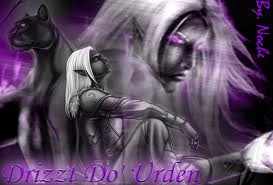
4. Drizzt Do’Urden:

Gotta give the dark elf considerable credit. He grew up in the Drow city of Menzoberranzan. where all males were merely fighters and concubines. Of course his mother and sisters abused him and tried to kill him, and by the time he discovered who his father really was, well…I don’t think he even got to bury him.

Suggestion: a bit stumped here. When your father gave you a genetic sense of justice, enough to turn you against your mother and sisters, what can you really reciprocate with? 
images-2

Artist – Noche

5. Frodo Baggins:

I admit, I had to look this up and cannot guarantee my sources. Frodo’s father was Drogo and we don’t know much about him other than he went and drowned in a boating accident. Hobbits should know not to participate in such dangerous and adventurous pastimes as boating. At least, Frodo had a nice secure upbringing with his first cousin once removed (and not his uncle as even dear Bilbo often referred to himself). It was not as though Bilbo passed on any artifact that was incredibly dangerous and held the fate of the entire Middle Earth!

Suggestion: Stay away from the jewelry!!!

images-3


In epic fantasy we gravitate to protagonists who are the underdogs, who overcome adversary, and make great personal sacrifice. But we also seem to be sending out a message to our young readers that the absent/weak/villain father is the norm.

It must not be so. Every young man deserves a father who is a role model, imperfect and flawed as we may be, but a father who will teach him to fish, nock an arrow, believe in a just society, and to be a good human being…or elf…dwarf etc.

I’m sure if we were to meet Luke, Eragon, Tyrion, Drizzt or Frodo in a pub, they would all agree that they wished they had fathers they could truly appreciate and learn from.

Perhaps being the best father you can is the greatest quest any of us can embark on. It may not save Middle Earth or Menzoberranzan, but it will make our world a better place to live in.

Happy Father’s Day.

—————————————————————————————————–

Alon Shalev writes social justice-themed novels and YA epic fantasy. He swears there is a connection. His latest books include: Unwanted Heroes and the 2013 Eric Hoffer Book Award for YA – At The Walls Of Galbrieth. Alon tweets at @elfwriter. For more about the author, check out his website.

Elves, Dwarves and Political Activists

“You can’t be serious!” she exclaimed, wrinkling her nose as though I had just made a pass at her, or uttered a politically incorrect sentiment. “You write about elves and dwarves running from one end of the world to another killing each other and making long speeches? I thought you were a serious writer.”

In honesty, she had not seen me for a few years, and even then, knew me in the context of my more political work environment. To her credit, she recovered and apologized, and I was able to refrain from pouring my drink into her lap. It was, after all, a good scotch.

images-2

Friend or not, intentional or not, it still hurt. I thought I had past this stage, smoothly presenting myself as ‘an author who writes in two genres’. I have practiced my opening line and it is now delivered with confidence.

I am involved in social justice causes. Even in my short eight years living in the US, I have built a fair resume of involvement. I have taken students almost every year to New Orleans, not only to help rebuild a community, physically and emotionally, but to bear witness so that the millennials will not make the mistakes we have. I have been involved in various campaigns here and abroad.  I know my local food bank well. Hey, you never had a black President before I came to the US! 

But yes, I love to lose myself in Middle Earth, Alaegasia, Westeros and, dare I add it to the list: Odessiya. It’s a nice break from the intensive campus environment to deal with stubborn dwarves and idealistic elves. While closeted in an urban concrete jungle, it is relaxing to ride a horse through ancient forests, over great ice plains, and to quaff an ale or puff a pipe (without the health risks) with good friends, all from a computer screen or ebook reader.

Fantasy1

 The San Francisco Bay Area is intensely populated by variety of the human species often identified by salt-and-pepper haired, wrinkled, colorful attire, and provocative bumper stickers. These aging ideologues have rich resumes of demonstrating against wars, civil rights. Watergate, and more recently, more wars, gay rights, and gun control.

While there are many who have fallen by the wayside, succumbing to burnout, those who have maintained their energy to keep demonstrating and fighting for what is right, all seem to have a secret place they go to recharge, relax, and to return energized to make the world a better place to live in. It might be literature, meditation, family, friends, food, nature … it doesn’t matter. As a friend once said: Fixing the world is a marathon, not a sprint.

hobbits in pub

Yeah, I write about elves and dwarves doing brave acts and striving for justice and honor. Sure I write about battles and loves, about friendships and magic, about the power of nature and good fighting evil.

It energizes me, often provides clarity and vision. And if I do occasionally wonder what Seanchai or Shayth might do about gun control or why some people are denied the rights and opportunities their neighbors have, well that’s because fantasy is not quite as far-fetched and detached from reality as my shocked friend might think.

God created the world in six day and on the seventh s/he rested…and may well have deservedly read Lord of the Rings.

 images-3

Here’s to whatever it takes for each of us to continue the journey we’ve chosen!

—————————————————————————————————–

Alon Shalev writes social justice-themed novels and YA epic fantasy. He swears there is a connection. His latest books include: Unwanted Heroes and the 2013 Eric Hoffer Book Award for YA – At The Walls Of Galbrieth. Alon tweets at @alonshalevsf and @elfwriter.   For more about the author, check out his website.

 

A Private Letter to George R.R. Martin

Dear Mr. Martin,

Let me begin by saying that I am a big fan. I have just finished Book 4 and, if that isn’t proof enough, I am preparing to read Book 5. I have sung your praises on my humble elfwriter blog and keep your photo under my pillow (I don’t – but I wanted to make sure I still had your attention).

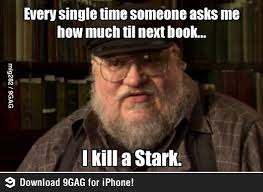
It’s like this, sir. One day I want to be a bestselling epic fantasy author like you. My third book comes out in the fall and I have probably sold as many books as you’ve killed noble characters (actually I might be being a bit optimistic there).

images-3

I spend a lot of time hanging out with other writers: online and (I know this is rare) actually in person. Everyone tells me to “observe the rules,” “don’t break the conventions,” and, my favorite, “Tolkien was one-of-a-kind. You wouldn’t get away with that.”

But you, sir, have broken the rules. You have tippexed (anyone?) over the conventions. One friend suggested that you only get away with it because you are already famous, already have a huge following, and probably don’t care anymore what anyone outside of the Seven Kingdoms thinks.

images-1

So here is my list of 10 things you have done wrong:

1. Your books are too long. I keep getting told that 90K is way beyond the commitment that most readers are willing to invest today. But then why do I enjoy them (and Christopher Paolini, and J.K Rowling, and some unknown ancient language, Oxford professor) and feel a sense of loss when they are finished? 

2. Your books are too slow. People want action, action, action. Instant gratification …debate in 140 characters or less. Have a car chase or blow up a bridge – well, you get my point.

3. Your books are too detailed. You mean I need to think? Concentrate? Invest? I hear you keep flow charts in your office – can we peek? How about a deal with Cliff Notes or an app that you can enter a character, your book and page number and get an update. Dude – I totally expect a commission on the app idea.

4. Your characters are too flawed (especially the good ones). If I’m not seeing Ryan Gosling or Kristen Stewart then it simply won’t do. If I want real people, I would put my book down and hit the pub.

images-2

5. Your characters are too dead. I actually wrote a blog post about this (I Need A Hero), keeping the book and you anonymous so as not to spoil it. Guess what? Everyone knew who I was talking about.

6. You drop some characters for hundreds of pages – are you tempting me to skip pages, sir? Just so as not to spoil this for any readers on Books 1-4, you know what I mean when I connect this to Book 4//5.

7. You miss out key scenes – battles in particular – and subtly let us know they have happened. I know it is incredibly difficult to write battles and only the best can pull it off, but well sir, you are one of the best.

8. You have too many minor characters. I hope you are keeping track of them because, to be honest, I am developing a habit of scratching my head whenever someone resurfaces 1-2,000 pages later.

9. You care more for the old gods and the new than the critics.

10. Your books are too addictive. I can’t stop…

You broke all the rules, sir. Congratulations! Now where is my copy of Book Five?

images

—————————————————————————————————–

Alon Shalev writes social justice-themed novels and YA epic fantasy. He swears there is a connection. His latest books include: Unwanted Heroes and At The Walls Of Galbrieth. Alon tweets at @alonshalevsf and @elfwriter.  

.


I Hope It Never Gets Old

This is actually the seventh time that I am on the cusp of a book being published. This count allows for a couple of self-published books that were both picked up by Three Clover Press and repackaged with new covers, titles, and an extensive round of edits. 

But I am as excited as I was the first time, and the second, and the third… You get the point. Sometime in the next two weeks, The First Decree, the sequel to At The Walls Of Galbrieth, will be officially released by Tourmaline Books.

The First Decree-hi resolution

I wonder how it is for the big fish? When those A-list authors have their 20th, 30th, or 40th novel released, are they just as excited? Yes, I’m thinking of you, Terry Brooks, George R.R. Martin, J.K Rowling. Are these authors and others coolly not checking their email every hour for the official notice from their publishers? Do they accidentally type their name into the Amazon.com search engine and browse down the list of books on their author’s name?

I am, of course, way to cool to be checking every hour, myself. In order to be productive at work and give my sons the attention they deserve, I have set reminders for four times a day – I’m awake for eighteen, I figure that’s okay.

I have not yet held my review copy. I remember each time it happened with almost the clarity of holding my newborn sons. The books, I have to admit, were not as slimy or noisy.

I am currently almost 40,000 words into writing the fourth book (yes, I said Book 4). But I have promised myself that once The First Decree is launched, I will stop and begin the process of my own edit for Book 3, before I send it off to editors, cover designers and formatters. 

The process is ongoing. Each magical, landmark moment: finishing writing the last page, sending the book to the editor, seeing the cover for the first time, receiving the review copy… these are all just stages in a journey to build not only a world, but a dynasty – a multi-generational world with a history of its own.

But that never stops these special moments being magical – and it never should.

The First Decree Axe
—————————————————————————————————–

Alon Shalev writes social justice-themed novels and YA epic fantasy. He swears there is a connection. His latest books include: Unwanted Heroes and At The Walls Of Galbrieth. Alon tweets at @alonshalevsf and @elfwriter.  

.


Sword and Gun Control

Epic Fantasy, among many genres, has the ability to whisk us away from reality and send us into a world of noble quests, ancient swords, and magnificent mythical animals. It also has the ability to offer wisdom for the world we live in and I have written about this before.

Airship10But sometimes it is really hard to let go and enter this world – or to return to the one we live in. I needed to write a post for this blog a day or so after the Sandy Hook Elementary School tragedy in Newtown, Connecticut, and I couldn’t. What can one possibly write on a blog like this? 

I searched the Internet, found something amusing and pre posted it. It was a cop-out; admittedly perhaps some much-needed comic relief. But I’ve been thinking about this ever since. If epic fantasy is anything more than escapism, then we should have something to say? 

When National Rifle Association VP, Wayne LaPierre, blames violent video games, perhaps to deflect the debate on gun control, we need to ask ourselves whether we as fantasy authors and readers are also glorifying violence. 

The fact we use bows and arrows, axes and swords instead of semi-automatic machine guns doesn’t make it cleaner. I admire (begrudgingly as it is sometimes hard to read) the gruesomeness of George R. R. Martin’s A Game of Thrones series. What he describes in his battle scenes are probably the closest we come to the reality of battle. 

imgres-8But I am stuck with the feeling that if we do not write about the darker side, how can we reach for the lighter? For a rainbow to appear, there needs to be a storm. We do have a responsibility not to glorify or keep the violence clean. I am not sure that I achieve this in At The Walls Of Galbrieth and especially not in the huge battles that take place in The First Decree. I am not sure how to even achieve this without excluding the young adults for whom I primarily write. I do not believe my 14-year-old son and his friends, who devour my books, should read A Game of Thrones because of the violence (and also the way he portrays sex).

How can we keep on moving forward after a tragedy? Does it not maybe become even more important not to give up? I’ll leave the last words to a couple of good friends.

FRODO: “What are we holding onto Sam?”

SAM: “That there’s some good in this world Mr. Frodo, and it’s worth fighting for.”

Frodo and Sam

——————————————————————————————————

Alon Shalev is the author of At The Walls of Galbrieth, Book 1 of The Wyccan Master series, which reached the Quarter Finals of the Amazon Breakthrough Novel Award 2012, released by Tourmaline Books. The First Decree, the sequel is due out in early 2013. Shalev is also the author of three social justice-themed novels: Unwanted Heroes, The Accidental Activist and A Gardener’s Tale. More on Alon Shalev at http://www.alonshalev.com and on Twitter (@elfwriter).

Top Current Epic Fantasy Novels

Amazon.com sent me list of their best-selling titles (see below). I thought we could springboard on it and see who is reading what. Are you reading any of these novels? What is the best epic fantasy novel that you have read in the last few months?

I am particularly interested in Terry Goodkind. I enjoyed watching Legend of the Seeker on TV, but never got into the Sword of Truth – his first novel. Have you been reading his books? Let me know.

Have a great weekend,

Alon

——————————————————————————————————

Alon Shalev is the author of The Accidental Activist and A Gardener’s Tale. He has written two fantasy novels and the first has been entered into the Amazon Breakthrough Novel Award in January 2012. More on Alon Shalev at http://www.alonshalev.com/and on Twitter (@elfwriter).

Alon


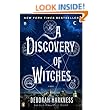
A Discovery of Witches: A Novel (All Souls Trilogy) A Discovery of Witches: A Novel (All Souls Trilogy)
by Deborah Harkness
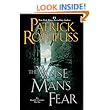
The Wise Man's Fear: The Kingkiller Chronicle: Day Two (Kingkiller Chronicles) The Wise Man’s Fear: The Kingkiller Chronicle: Day Two (Kingkiller Chronicles)
by Patrick Rothfuss
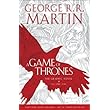
A Game of Thrones: The Graphic Novel: Volume One A Game of Thrones: The Graphic Novel: Volume One
by Daniel Abraham, George R.R. Martin
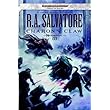
Charon's Claw: Neverwinter Saga, Book III Charon’s Claw: Neverwinter Saga, Book III
by R.A. Salvatore
Confessor (Sword of Truth) Confessor (Sword of Truth)
by Terry Goodkind
Cry Wolf (Alpha and Omega, Book 1) Cry Wolf (Alpha and Omega, Book 1)
by Patricia Briggs
Guild Wars : Ghosts of Ascalon Guild Wars : Ghosts of Ascalonby Matt Forbeck
The Wheel of Time, Boxed Set II, Books 4-6: The Shadow Rising, The Fires of Heaven, Lord of Chaos The Wheel of Time, Boxed Set II, Books 4-6: The Shadow Rising, The Fires of Heaven, Lord of Chaos
by Robert Jordan

Epic Fantasy’s Hall of Fame

Being new to the wonderful world of fantasy, I am published in political and transformation fiction, I am greatly in debt to Castle Fiction for a list of past and present masters. The comments after the names are mainly from the Castle Fiction, but I would love to hear which you have read and how you felt about them.

Past Major Fantasy Authors:

William Morris I admit that I have never heard of William Morris and understand that this is a hole in my education. I consider Tolkien to be the father of modern-day epic fantasy but apparently this is incorrect. “It all started with the publication in 1892 of the William Morris novel The Well at the World’s End. This is an outstanding piece of Epic Fantasy and it is considered to be the first epic fantasy work of the modern era. The same applies for another Morris novel titled “The Wood Beyond the World.”

Edith Nesbitt A prolific author at the end of the 19th century she created a genre of children’s fantasy literature. It often had normal contemporary children who engaged in magical adventures and discovered magical objects. She set the genre for many contemporary writers including J.K. Rowling. Some of her notable books are Five Children and It and The Story of the Amulet.

J.R.R. Tolkien A master of the craft that created the complete world of Middle Earth which included maps, languages and much more. Most notable works is the Lord of the Rings Series.

Tolkien - Middle Earth Master

Edgar Rice Burroughs Early twentieth century writer that created memorable characters and explored different worlds. His most memorable character is Tarzan. And his most popular series of books include the Barsoom series which takes place on Mars. The Venus series and the Pellucidar series which takes place within the hollow earth.

Robert E. Howard Mid 20th century writer who was a heavy contributor to the pulp fiction magazines. He is generally credited with creating the swords & sorcery genre. His most notable character is Conan.

T.H. White Mid 20th century writer who penned several books in the King Arthur tradition. The most notable of which is The Sword in the Stone which ushered in the modern Arthurian novel. Of note was a posthumous publication of his novel The Book of Merlyn

E.R.R. Eddison Considered to be the father of High Fantasy he wrote several books that influenced authors to come such as Lewis and Tolkien. Of his highly imaginative worlds The Worm Ouroboros is one of the most famous.

C.S. Lewis He was a scholar of medieval literature and mythology penning many works in a variety of genres including fiction, religious fiction and science fiction. His most notable works are the epic fantasy Chronicles of Narnia.


Present Major Authors:

Terry Brooks In the late 70’s Brooks published the novel The Sword of Shannara. It climbed to the top of best seller lists and stood there for years. Heavily drawing on Tolkien this book reintroduced the epic fantasy to the general public. Brooks continued the Shannara series with several more books. He has gone on to pen even more series.

Scene from Sword of Shannara

Terry Goodkind Writer of the Sword of Truth series which began with Wizards First Rule This is a solid series that takes a more serious approach to epic fantasy. The books explore philosophical questions. The series became a TV series – Legend of the Seeker – which lasted for two seasons.

Robert Jordan Is the writer of the enormously successful Wheel of Time series which is currently eleven volumes. He has also written many works based on the Robert E. Howard Conan character.

Stephen Donaldson Creator of The Chronicles of Thomas Covenant series of books which now number seven volumes and is most notable for its use of the anti-hero in which the main character maintains a reluctance to actually take on the mantle of the hero. He has written several other series in the genre.

Marion Zimmer Bradley Editor of the famous sword and sorcery series Bradley is also a prolific writer. Most notable among her writings is the Arthurian Avalon series which begun with The Mists of Avalon.

David Eddings Writer of sword & sorcery and epic fantasy series he is most famous for the Belgariad and the Mallorean series.

Raymond Feist Many of his works are set in the connected worlds of Midkemia and Kelewan. This is called the Riftwar series and the novels range over various geographic locations and span centuries. He began his writing with the first novel in the Riftwar series called Magician: Apprentice. Another series of note is the Krondor series.

Robin Hobb Is the author of several popular trilogies including The Farseer Trilogy, The Liveship Traders Trilogy and The Tawny Man Trilogy

Stephen King Although considered to be the master of horror King has published an enormous body of work in the fantasy genre. He crosses genre at will and breaks all the rules but notable is his Dark Tower Trilogy and The Eyes of the Dragon which is classic fantasy.

L.E. Modesitt Author of several series most notable are The Corean Chronicles
Set on the world of Corus (or Acorus), where strange and dangerous beasts roam and people with magical Talent can commit astonishing feats. Also is The Spellsong Cycle and The Timegod’s World which draws heavily on Norse legend.

George R.R. Martin Most notable for his Song of Ice and Fire series which was begun with A Game of Thrones in 1996.

Tad Williams Writer of several fantasy series the most notable of which Memory, Sorrow, & Thorn which was begun with The Dragonbone Chair

J.K. Rowling Creator of the enormously popular Harry Potter series which began with Harry Potter and the Sorcerer’s Stone. These books have also been transformed into successful movies.

David Farlane – The Author of the Acclaimed Runelords series. The fifth book has just been published and the first book is being made into a major motion picture.

What are your favorite authors of High or Epic Fantasy? Do you agree with the comments added above?

——————————————————————————————————

Alon Shalev is the author of The Accidental Activist and A Gardener’s Tale. He has written two fantasy novels and the first will enter the Amazon Breakthrough Novel Award in January 2012. More on Alon Shalev at http://www.alonshalev.com/and on Twitter (#elfwriter).

Why Fantasy? Another Perspective

Last weekend, I shared some comments from adults explaining why they read fantasy. A friend sent me this article by Lev Grossman, author of “The Magicians” and the recently released “The Magician King.”

The Magicians - Lev Grossman

In the article, Grossman talks about the excitement generated by the release of George R.R. Martin’s “A Dance With Dragons.”

“The book has brought with it, along with the feverish excitement of fans like myself, a whiff of burning insulation. There’s a cultural short circuit happening somewhere in the system.”

What I believe is creating the stir is the fact that while Mr. Martin’s work is clearly fantasy, it does not adhere to the formulas of such leaders as J.R.R. Tolkien and C.S. Lewis. Martin includes a fair helping of blood and sex in his continent of Westeros than the Pevensie children ever saw in Narnia. Something has changed.

Grossman shares his frustration at the perception that fantasy is for children and adults who are in denial that they are adults and seeking some escapism. “I see it all the time. I’ll be at a dinner party, and the person next to me asks me what I do. I’m a novelist, I’ll say, and a little light of hopeful interest kindles in their eyes. What kind of novels do you write? the dinner guest asks. And I reply: fantasy novels. And just like that, the little light of hopeful interest dies away.”

This story really resonates with me. Every week at the Berkeley Writers Group, I meet new people and introduce myself as an author of political fiction. Then when I prepare to read my weekly offering, I apologetically explain that I wrote a fantasy novel with my eldest son. All true of course, but I am conscious that I feel the need to justify. Why is this?

Lev Grossman

Grossman goes on to say: “It hasn’t always been this way. There was a time when adults read fantasy with impunity. The classical literature of Greece and Rome is so fantastical that you can’t swing a cat without hitting a god or a witch or a centaur, and chances are the cat will turn out to be somebody’s long-lost son-in-law in transfigured form.”

Right on! Stephen Wenster backs him up by asking where “would Shakespeare have been without fantasy—his spirits, his ghosts and the witches three of Macbeth?”

Apparently fantasy, without being labeled as a genre was prominent throughout literature history: “Where would Spenser’s “Faerie Queene” be without fairies? Where would Shakespeare have been without fantasy—his spirits, his ghosts, and his proto-Orc Caliban, the misshapen villain of “The Tempest”? You can’t have Macbeth without the witches three. Apart from everything else, who would have handled all that crucial exposition of the play’s plot?”

Absolutely!

Grossman, who holds a PhD in Comparative Literature, claims the downfall began around the time of Samuel Johnson. Perhaps this was the time that the advent of science meant they actually began to believe that ghosts and magic really didn’t exist.

Again, Lev Grossman: “A fascination with the here and the now and the real set in. This was the moment when the novel arose in the West, and it was an ideal medium to satisfy that fascination. Novels were about the way we live now. There was no Caliban on Robinson Crusoe’s island, just the eminently human Friday.

“In 1750, Samuel Johnson wrote an influential essay in praise of fiction that was about “life in its true state, diversified only by accidents that daily happen in the world.” As far as he was concerned, a good novel “can neither employ giants to snatch away a lady from the nuptial rites, nor knights to bring her back from captivity; it can neither bewilder its personages in deserts, nor lodge them in imaginary castles.” Thus admonished, ghosts and witches went off to live in fairy tales and allegories and gothic novels and other disreputable places.”

So history is against us, perhaps because people really did once believe in magic and ghosts. But I believe that in accepting there is nothing factual in elves, dwarfs etc. we can focus on allowing values to play a prominent role because, as Grossman say: “If anything, it is realist literature that pretends to be real. Fantasy doesn’t pretend.”

Fantasy is one of the few literary genres left where it is still considered okay to explore questions of moral judgment. But that’s not a bad thing. When the powerless and good become empowered and are able to change the destiny of their world, there is something that resonates in a world where so many feel alienated and disenfranchised. When coming-of-age can happen at any age, why would an adult still hoping to leave his/her mark on the world not be attracted to such novels?

——————————————————————————————————

Alon Shalev is the author of The Accidental Activist (now available on Kindle) and A Gardener’s Tale. He has written two fantasy novels and the first will enter the Amazon Breakthrough Novel Award in January 2012. More on Alon Shalev at http://www.alonshalev.com/and on Twitter (#elfwriter).