The Power Of The Bow – repost

Over the three days of November 17 -19, Amazon.com have decided to promote the 2013 Winner of the Eric Hoffer Book Award for YA – At The Walls Of Galbrieth. The novel will be offered FREE in ebook form.

This is a wonderful opportunity for me and I request that, to support my sales rank and me, you download the book and invites your friends to do the same. Feel free to gift it on (Thanksgiving and Hanukkah, anyone?).

To celebrate this and also the milestone of 100 blog posts on elfwriter.com, I wish to offer 10 of my favorite posts over the next three days. I hope you enjoy and, please, take a moment to download for FREE At The Walls Of Galbrieth and spread the word.

Thank you,

Alon

 =======================================

There is a children’s movie just come out, Brave, with the heroine sporting a bow and arrow. Katnis, from the Hunger Games, was lethal with one. Legolas was extremely handsome even in the midst of a desperate fight for Helm’s Deep and never missed when he let fly.

It seems that a bow and arrow are integral ingredients in fantasy, even when the setting is modern enough for guns and technology. Bows were, of course, around before fantasy. Who can forget Robin Hood in the archery contest splitting his opponent’s arrow, which had pieced the center of the bull’s-eye? Classic.

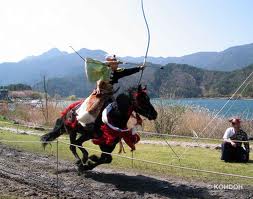
And then there are the Samurai with their beautiful longbow, the Yumi. They didn’t just shoot it with their distinctive technique, but held a philosophical discipline, kyūjutsu, akin to Tai Chi and other spiritual martial arts.

Even after the bow became outdated as an effective weapon it remained a form of training for its warrior code value. The yumi was also fired from horseback because of its asymmetric shape and this practice evolved into a Shinto ceremony known as yabusame. At the risk of sounding trite, there is a beautiful scene in The Last Samurai, with the yumi being explained and fired.
In the West we have also been drawn to the spiritual values of the bow. Eugen Herrigel’s classic, Zen in the Art of Archery, is still a classic fifty years after he wrote it. My 13-year-old has become obsessed with archery. He made his own bow and learned how to shoot it from a teacher. He takes classes at camp and has spent over a year saving up to buy a ‘real’ bow. When I wrote two scenes in the third Wycaan Master book, he provided me with a lot of excellent and rich information. 

I’m still struggling with why the bow is so captivating. For some reason, I am not questioning the sword in the same way. Use of the sword is elegant, noble and also has numerous philosophies and katot (martial art form), but there is something that sets the bow apart and keeps us coming back for more.

Any ideas? Would love to hear in the comments below.  

=======================================


Alon Shalev is the author of the 2013 Eric Hoffer YA Book Award winner, At The Walls of Galbrieth, offered by Amazon.com  for FREE on November 17-19. The sequel, The First Decree, and Ashbar – Wycaan Master Book 3 are all released by Tourmaline Books. More at http://www.alonshalev.com and on Twitter (@elfwriter). Hang out with Alon on Google+

Elves in Coffee Shops – repost

Over the three days of November 17 -19, Amazon.com have decided to promote the 2013 Winner of the Eric Hoffer Book Award for YA – At The Walls Of Galbrieth. The novel will be offered FREE in ebook form.

This is a wonderful opportunity for me and I request that, to support my sales rank and me, you download the book and invites your friends to do the same. Feel free to gift it on (Thanksgiving and Hanukkah, anyone?).

To celebrate this and also the milestone of 100 blog posts on elfwriter.com, I wish to offer 10 of my favorite posts over the next three days. I hope you enjoy and, please, take a moment to download for FREE At The Walls Of Galbrieth and spread the word.

Thank you,

Alon

 =======================================

It happened earlier this week in the Financial District of San Francisco. It was a rainy workday and I was sitting in a café editing Wycaan Master, my fantasy novel, when these two beautiful women entered. I’m a guy: I peeked, taking in their tightly, swept back hair, high cheek bones and narrow eyes, all accentuated by carefully applied makeup. They were both tall and thin.

Then I realized. I had been disappointed as my gaze moved to their ears. Their ears were not pointed!

I was shocked. I had really expected pointed ears? It’s this elf thing…it’s taking over. When I am writing a story I am absorbed…totally. Even when editing, I am completely caught up in the story. I can read an emotional scene a dozen times and still be moved to tears (Confession: I once cried during a Simpson’s episode, but that’s for another time).

However more recently I am taken when I see someone who might fit into my fantasy world. A walking stick becomes a staff, and I expect a short, bearded man to have an axe at his side, not an iPhone.

It is taking over.

I’m not the first to stumble down this route. In his excellent book about writing fantasy, Terry Brooks admits to disappearing into the world of Shannara.  Often it happens when he is at the dinner table or with family or friends. His eyes (so he is told) gaze into the distance and everyone understands.

Now Terry Brooks can get away with it for three reasons:

1) He is older and entitled to a senior moment.

2) He is a best-selling author and there is nothing like success to romanticize a little eccentricity.

3) He is such a mensch.

While I will one day be older, if the gods allow, the success isn’t assured. I am going to have to learn to curb my imagination, to stay in this world until sleep or time in front of a computer allows. A few glasses of single malt can also help.

But I don’t want to block it. My characters are part of my life, their challenges are my problems, and their triumphs are my successes. If I block them out just once, will they come back when I beckon them?

It’s tough living in two separate worlds, but I wouldn’t have it any other way.

Finally, it is St. Patrick’s Day. Did you know the Irish for whiskey is ‘Uisce beatha’, which literally means ‘water of life’?

Live Green My Friends.

  ——————————————————————————————————

Alon Shalev is the author of the 2013 Eric Hoffer YA Book Award winner, At The Walls of Galbrieth, and five other Wycaan Master books all released by Tourmaline Books. The link above takes you to the Kindle versions. For all other eReaders, please click here.

More at http://www.alon-shalev.com and on Twitter (@elfwriter).

The Gods Of Fantasy – repost

Over the three days of November 17 -19, Amazon.com have decided to promote the 2013 Winner of the Eric Hoffer Book Award for YA – At The Walls Of Galbrieth. The novel will be offered FREE in ebook form.

This is a wonderful opportunity for me and I request that, to support my sales rank and me, you download the book and invites your friends to do the same. Feel free to gift it on (Thanksgiving and Hanukkah, anyone?).

To celebrate this and also the milestone of 100 blog posts on elfwriter.com, I wish to offer 10 of my favorite posts over the next three days. I hope you enjoy and, please, take a moment to download for FREE At The Walls Of Galbrieth and spread the word.

Thank you,

Alon

 =======================================

Pass a summer evening in a quaint English pub, mid 20th century, perhaps in the old town of Oxford. Caress a pint and listening to a few graying professors discuss semantics, philosophy, and the ancient languages long forgotten outside the sheltered walls of academia. What else can one possibly ask for? 

imgres-1

Imagine these tweed-clad, pipe-smoking academics, hatching more than another challenging semester to try the greatest minds of this fair isle. Each is a king in the making or, more accurately, a kingmaker. For they direct more than the destiny of kings and noble houses. They raise kingdoms and conquer lands. They build great dynasties, bring whole species back from the mists of extinction, and set those of noble birth and principle to stand against evil.

Sip your beer, mull over the words, much of which you might not understand. Dwarves, elves, of course: but hobbits? Marsh-wiggles? Listen as the professors strategize great battles, masterfully marshalling unicorns, dragons, giants, minotaurs and proud ents.

You slowly realize that you sit among the Gods, the creators of Middle Earth and Narnia, who hold court on Tuesdays at midday in a local public house. Perhaps it is The Eagle and Child, or The Lamb and Flag across the street. They read each other’s work and offer critique as writer’s groups have for centuries and continue to do so today.

220px-Birdandbaby

I may never have understood much or been accepted into such an elite. They would have torn my work to shreds on grounds of philological shallowness (I had it checked – it’s not contagious), criticized me for imprudently suggesting that a 100,000 word novel can serve as more than merely an introduction.

They would have demanded richer world-building – take twenty pages to describe a forest, I dare you – unyielding heroes, and infallible plots. They would have challenged the age-old legends dressed up in fictional costumes, and raised an eyebrow at some of the language or innuendos.

Most likely, I would never have dared reveal my stories to the old professors of Oxford, to the most famous writing group in history. I would never have been more than a fly on the wall at a meeting of The Inklings, but would have returned week after week to sit at the feet of the Gods and hear their banter.

For here the Gods gave birth to great worlds and left them as a legacy to us and to our children, long after they departed this world. Every Wednesday night, I sit around a table in a coffee shop in Berkeley, sharing work with other aspiring authors and wonder: do the Gods look down upon us from Writers Heaven?

lewis-and-tolkien1

Do they tut and shake their heads at our adverb addiction, our unwillingness to kill our darlings? Or do they even now move pieces around the literary chessboard. Protect the king! Advance the knights! Who, I wonder, are the pawns?

As we write a new book, a new chapter, do we not imagine the Gods walk among us?  Do they peer over our shoulders at our swanky writing machines, judging every word we write, every world we build? 

The Gods once sat in an old English pub. Now they stand behind us in coffee shops and at kitchen tables, urging us on, watching us walk the path they forged, taking on the quest they started.

For the Gods still walk among us and inside of us. The stories have been told but must be told again in different ways to a different generation. We sign these books in our own names, but humbly acknowledge those who molded us in their image as storytellers.

And now they are the flies on the wall and we who pound the keyboards. Take a moment, draw another pint, and raise your glass:

To the Gods of Fantasy!

 =========================================

Alon Shalev is the author of the 2013 Eric Hoffer YA Book Award winner, At The Walls of Galbrieth, offered by Amazon.com  for FREE on November 17-19. The sequel, The First Decree, and Ashbar – Wycaan Master Book 3 are all released by Tourmaline Books. More at http://www.alon-shalev.com and on  Twitter (@elfwriter). 

Possessed Writers – repost

Over the three days of November 17 -19, Amazon.com have decided to promote the 2013 Winner of the Eric Hoffer Award for YA – At The Walls Of Galbrieth. The novel will be offered FREE in ebook form.

This is a wonderful opportunity for me as an author and I request that  you download the book and invites your friends to do the same. Feel free to gift it on (Thanksgiving and Hanukkah, anyone?).

To celebrate this and also the milestone of 100 blog posts on elfwriter.com, I wish to offer 10 of my favorite posts over the next three days. I hope you enjoy and, please, take a moment to download for FREE At The Walls Of Galbrieth and spread the word.

Thank you,

Alon

 =======================================

The scene might be the same in any house mid-week, early evening.

Your partner is rushing to make dinner, still in his/her office clothes. Ten- year-old son is irritable, primarily because he preferred to play wall ball than eat his lunch at um … lunch break. He has even pointed out that the First Lady wants him to exercise more (you just lost my vote in 2020 Ms. Obama! Tell him to eat that sandwich we made him). Older son is drowning in homework and needs help. Unfortunately it is not math where he ends up explaining it to a perplexed calculator-wielding father – it is English and father is the fastest typist in the house.

images

From within this maelstrom, hassled wife turns around from steaming cooking pots and sees an unset, messy dinner table, a swivel chair, and a writer’s desk. The writer, sitting in said chair, is distinctly facing the wrong direction, pounding his keyboard with a vengeance.

Suddenly, she can’t help herself. Forgetting the wooden spoon in her hand (writers notice these details especially when the spoon is being flailed in said writer’s direction), she towers over the writer, hands on hips:

“You’re writing? Now? Man, you are just possessed!”

When my extremely patient and understanding wife says something like this, it does makes you wonder. The problem is that after a stressful few months, I had a week off over the Christmas break, and kind angels put our family up in beautiful, snowbound Tahoe, 10,000 feet high in the Sierra Nevada mountain range.

Already on crutches from a knee operation, I was never going to cut the crisp, fresh snow on virgin slopes (I don’t ski even when not on crutches – at best I tumble down a 100 feet nursery slope, make sure there are photos, and then slink off for laced hot chocolate).

images-1

But here, if only for a few days, I couldn’t help myself. The laptop comes on and a few snow-bound scenes of a new book somehow appear.

Possessed? Moi? Five months and 103,000 words later, despite an intense period at work and many other obligations, I type the final period, click the save command, and stare at the epilogue. Rough first draft of Wycaan Master Book 4 is completed.

This latest book was written mainly between 7.30-8.30 am and after the boys go to bed on weekdays, and a couple of hours on the weekend, or random pieces written during odd times. Or while waiting at the dentist, on the mass-transit BART commuting home, in San Francisco, Washington DC, Ventura, St. Louis, San Diego, and at too many airports.

images-3

Possessed? Nah. Possessed would be finishing Book 4 and starting to write scenes of Book 5. Possessed. Out-of-control. Crazy.

I just wrote a few pages, honestly, mainly plot threads that I want to develop, characters that need to grow and confront their pasts. There is a bit of world-building with oceans and…

Starting Book 5 might just be considered grounds for divorce, need to involve Family and Children Services, or a good psychologist (preferably one who is as much a fan of Tolkien as of Freud). 

Starting Book 5? “Now? Man, you are just possessed!”

Fair point.

 =========================================

Alon Shalev is the author of the 2013 Eric Hoffer YA Book Award winner, At The Walls of Galbrieth, offered by Amazon.com  for FREE on November 17-19. The sequel, The First Decree, and Ashbar – Wycaan Master Book 3 are all released by Tourmaline Books. More at http://www.alonshalev.com and on Twitter (@elfwriter). Hang out with Alon on Google+

The Magic Is Everywhere – repost

Over the three days of November 17 -19, Amazon.com have decided to promote the 2013 Winner of the Eric Hoffer Award for YA – At The Walls Of Galbrieth. The novel will be offered FREE in ebook form.

This is a wonderful opportunity for me as an author and I request that you download the book and invites your friends to do the same. Feel free to gift it on (Thanksgiving and Hanukkah, anyone?).

To celebrate this and also the milestone of 100 blog posts on elfwriter.com, I wish to offer 10 of my favorite posts over the next three days. I hope you enjoy and, please, take a moment to download for FREE At The Walls Of Galbrieth and spread the word.

Thank you,

Alon

 =======================================

Last weekend, our family headed for the marina, a grassy area on the west point of Berkeley that looks over the San Francisco Bay Area. We have been there many times to fly kites, play soccer, run and bike. 

This time, armed with a blanket and picnic, we were planning on some serious reading. Older son had a book assigned from school, a historical fictional account of many good people dying from a plague back in the 1700’s: perfect depressing material for the summer vacation. Not surprisingly, he hadn’t embraced the intrusion with the enthusiasm he showed for Christopher Paolini’s Eragon or J. K. Rowlings’ Harry Potter.

It was surprisingly windy and we made for some bushes and trees that would deny us the view, but offer shelter. We spread the blanket and I fell into my stadium chair and flicked on my Kindle.

While I waited for it to fire up, I glanced to my left. Between the bushes and the trees was a tunnel, with brush growing up and over so that you could barely see the sky. It was dark inside with the promise of sunlight on the other side. My youngest son, I realized, was staring at it as well. He turned to me.

“What do you think is through there?” he asked, eyes wide open.

“I don’t know,” I replied, the right level of gravity in my voice. “Think you should check it out?”

He nodded, rose and moved into the tunnel. He never came out…

Okay, that is not exactly true. But he stayed in the tunnel and explored beyond. Sometimes he sat and read his book, and other times played, creating his own world. Finally, he called for me to join him.

“The tunnel is safe,” he declared, “but there are dragons on the other side. Be careful.”

I knew that on the other side was a view of the Golden Gate Bridge, Alcatraz, San Francisco, and the bay with many sailboats. But as his tiny hand took mine and guided me out the other side, all I saw were the dragons.

Others might have seen a red kite with a long tail, to its left was a blue-green one tearing through the sky in acrobatic maneuvers, but we saw two dragons eying each other. My son announced with authority that they were deciding whether to fight or be friends. Remembering my politically correct role as father, I said I hoped they would be friends. 

But as I watched them and glanced back at the tunnel, it was my imagination that soared. Perhaps a new book is fermenting, or only a scene in the next Wycaan Master. Maybe it will surface next year or in a decade, but it is stored away.

And this moment of magic only happened because I was ready to embrace it, albeit with a little help from a nine-year-old with a rich imagination. But then I have seen elves in coffee shops.  

=========================================

Alon Shalev is the author of the 2013 Eric Hoffer YA Book Award winner, At The Walls of Galbrieth, offered by Amazon.com  for FREE on November 17-19. The sequel, The First Decree, and Ashbar – Wycaan Master Book 3 are all released by Tourmaline Books. More at http://www.alon-shalev.com and on Twitter (@elfwriter). 

When Is An Elf Not An Elf?

Over the three days of November 17 -19, Amazon.com have decided to promote the 2013 Winner of the Eric Hoffer Book Award for YA – At The Walls Of Galbrieth. The novel will be offered FREE in ebook form.

This is a wonderful opportunity for me and I request that, to support my sales rank and me, you download the book and invites your friends to do the same. Feel free to gift it on (Thanksgiving and Hanukkah, anyone?).

To celebrate this and also the milestone of 100 blog posts on elfwriter.com, I wish to offer 10 of my favorite posts over the next three days. I hope you enjoy and, please, take a moment to download for FREE At The Walls Of Galbrieth and spread the word.

Thank you,

Alon

 =======================================

WHEN IS AN ELF NOT AN ELF?

Yes, my novel is compelling, special, well-written etc. just like the 499 other epic fantasy manuscripts sitting in the slush piles of every publishing house that offers YA epic fantasy.

I am working with an agent who is asking the challenging and insightful questions that will help my manuscript stand out from the rest. It is tough and I am feeling very possessive. Last week I shared his prompting to seek a Higher Concept.

One of the aspects that he wants me to consider is changing my elves, who make up many of the main characters and cultural references. He suggests that I consider changing the elves for a new, mythical race that will set me apart from the rest.

Let me state from the outset that I have no doubt this man knows far more than I about the publishing world, has considerable experience and understands the current state of the publishing world.

But my elves? Our elves? Those of us who grew up on Tolkien, Paolini, Brooks and others, have standards, images, friends. Legolas and Anwen, Arya and Blodgarm, and many others have created a rich and familiar texture. We welcome them surfacing as we settle into a thick novel. We embrace them because there are common threads that pass between authors. We call it a culture, those who don’t read fantasy roll their eyes.

                               Noble Haldir – we owe him for Helm’s Deep, no?

Terry Brooks’ children know that he is not all there, he tells us as much when he opens his book Sometimes the Magic Works: Lessons from a Writing Life. More on this book in a later blog.

But Brooks in not dissimilar to the rest of us, just considerably more talented! We pass through a gate in our imagination and reacquaint in a world that exists in a shared consciousness.

Here the elves are tall, thin, light-footed and beautiful. They are fast and posses stealth and discipline. They are in touch with the energy of the earth, the forest, the animal kingdom. They excel in archery, crafts and healing. Perhaps they are aloof, elitist, and closed to the other races, but this comes from their ancient and rich heritage. We know and love them.

We rejoiced to learn that Peter Jackson is bringing Legalos into a prominent role in The Hobbit. Well, a few raised eyebrows, since Legalos was not even referred to by name in The Hobbit when he appeared flanking his father, the King of Mirkwood.

We accept, even with a bit of jealousy that he can fight at Helms Deep for five days, or run non stop for three and still not need to brush his immaculate hair. Nor do we care that his quiver seems to replenish itself, an occupational hazard of any archer who fights battles every other day.

We don’t mind because elves epitomize something that we identify with. We all want to be beautiful, brilliant, in excellent physical condition and, of course, environmentalists. When R.A. Salvatore created Drizzt Do’Urden and the dark elves of Menzoberranzan, a giant underground drow city-state he broke new ground.

Many of us were repelled and had it not been created in the hands of a master of fantasy, we would have rebelled. It was daring, it worked and by Book Three, we were rewarded with the typical elf one finds above ground.

It is tough to turn away from the basic tenets of epic fantasy: the teacher and student, the quest, the fight against a powerful evil, dwarves, elves, dragons, a rich natural world. There is something that has entered our collective consciousness and taken root.

It is why we read and reread the masters…and it is why we will return to read those who take over the role of entertaining us in a way that only epic fantasy does.

 =========================================

Alon Shalev is the author of the 2013 Eric Hoffer YA Book Award winner, At The Walls of Galbrieth, offered by Amazon.com  for FREE on November 17-19. The sequel, The First Decree, and Ashbar – Wycaan Master Book 3 are all released by Tourmaline Books. More at http://www.alonshalev.com and on Twitter (@elfwriter). Hang out with Alon on Google+