T is one tough 7th Grader – Tim O’Mara

Elfwriter’s Introduction:

Tim O’Mara is a hero. He is a public school teacher and a man (rare to have male role models in our schools). Like most of these dedicated, hard-working, under-rewarded, and under-recognized teachers, he cares about his students. I am very inspired by him and very grateful as a father and a citizen to all public school teachers.

But Tim is not just an  NYC public middle-school teacher. He is an author. He wrote an adult mystery series about a public schoolteacher who used to be a cop. O’Mara never was a cop, but his brother is. Raymond Donne Book 1, Sacrifice Fly (2012 Minotaur Books), was nominated by Deadly Pleasures Magazine for the 2013 Best First Novel Barry Award.

O’Mara teaches math and special education in a tony area of Manhattan now, but started his career in 1987 in a disadvantaged section of Williamsburg, Brooklyn, the setting for the series. The dichotomy of these two worlds is highlighted in Raymond Donne Book 2, Crooked Numbers, released this past week. More at www.timomara.net and on Facebook (TimOMaraAuthor) and Twitter (@TimOMaraAuthor).

Support a teacher – and read a good mystery book.

mail.google

Tim’s Post:

You know the type: hard to reach, easy to annoy, always knows more than the teacher. In this case, me. The kid’s got a wall around him that would make the Chinese envious. But on those rare occasions when he lets me glimpse over that wall, the view is astounding. He can be funny, insightful and a joy to teach.

He mentioned to me last week that he knew I’d written a book, Crooked Numbers. I had given a copy to a friend of his—another of my tougher students—to celebrate a successful session at camp and the birth of his foster mom’s first child. That was pretty much all T said. He knew I wrote a book.

For most of last year, there was a bit of a buzz around school that Mr. O’Mara had published a book and that it was in bookstores and it was even available online and their parents had bought it and liked it. Some kids actually brought copies to school to have me sign, and even though I wrote it with an adult audience in mind, it seemed to strike a chord with many of my middle school students.

If T was impressed, he kept it to himself.

Just last week, T stepped into it again. He earned himself a one-day suspension for creative use of a belt and ended up spending the day in the principal’s office. Shortly after school ended that day, my boss came to me in the Teacher Center. It turns out that during a conversation with the principal, it came out that T was somewhat impressed with my accomplishment and he was even thinking about going to the reading and signing event for my second book this week.

“Maybe you can work with that,” my boss suggested.

Maybe.

The next day, I brought in a personally inscribed copy of the book. I referenced a conversation I had had with him the day of his suspension:

To T,

This story has a lot to do with the choices people make—including the author.

I gave him the book immediately after a particularly positive period with him of one-on-one guidance through a quiz on integers. (Yes, pun intended.) He looked at the inscription and nodded. He didn’t say anything. I said, “You’re welcome,” and went off to do lunch duty.

When I go back to school tomorrow, it will be the first encounter with T since I gave him the book. My fantasy is that he stayed up all weekend reading the book, relating to the characters, and realizing the error of his ways. The reality is the gift of a book—my book—will more than likely not change much of anything. It has taken T thirteen years to build that wall and one present from a teacher is not going to tear it down.

What I’m hoping for is just one little crack.

mail.google-1

——————————————————————————————————

Alon Shalev is the author of the 2013 Eric Hoffer YA Book Award winner, At The Walls of Galbrieth, The First Decree, and Ashbar – Wycaan Master Book3, all released by Tourmaline Books. Shalev is also the author of three social justice-themed novels including Unwanted Heroes. He swears there is a connection. More at http://www.alonshalev.com and on Twitter (@elfwriter).

Another Author Writes For His Sons

Just a short post that reflects a frantic week. I often surf YouTube for author interviews when making dinner or cleaning the kitchen. Often they are enlightening about an author’s writing craft or their personal connection to their work. Sometimes I uncover a gem.

This is a great clip of Neil Gaiman (you need about 20 minutes – so don’t do this at work. People might hear you laugh out loud and worry!). You have to admire him for his charisma, speaking skills, sense of humor, and well, for me that he write a story for his children.

Rock on Neil Gaiman.

I shared a great talk by Terry Brooks on this blog and also Terry Goodkind.

—————————————————————————————————–

Alon Shalev writes social justice-themed novels and YA epic fantasy. He swears there is a connection. His latest books include: Unwanted Heroes and the 2013 Eric Hoffer Book Award for YA – At The Walls Of Galbrieth. Alon tweets at @alonshalevsf and @elfwriter. For more about the author, check out his website.

Guest Post from Elwin Cotman – exciting young author.

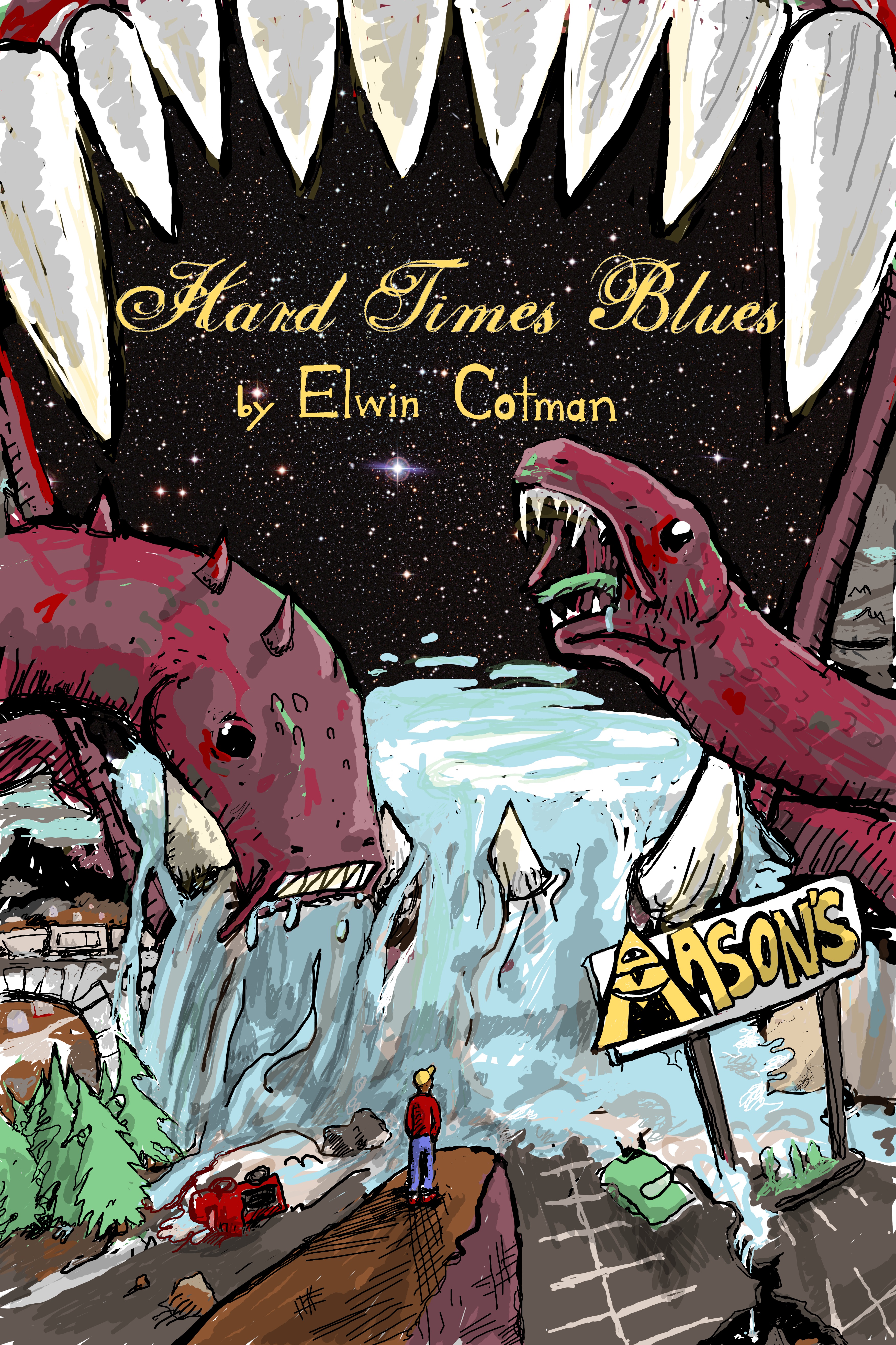
Elwin read his previous collection, The Jack Daniels Sessions to our writers group. His new book – Hard Times – is out and his book launch is at Pegasus bookstore in Berkeley later this week. Elwin has a uniques way of writing, but his voice when reading is amazing. Well worth an evening.

Me3

Back to Reality

1To the bearer of the sandbag: slide back two steps for every one you gain, because the levee does not give ground easily.

2Leper steps, needles pricking his calves and thighs.

3His life measured in steps of ten, one after the other, then again.

4Behind the rifle aimed at his cheek: a hairy face plastered with three stripes of black hair and his

5Eyes like the heads of rusted nails, lips drawn back from broken teeth.

6The deputy kept as close to him as a brother, his curses swallowed by the storm.

7Or maybe he had lost his voice and moved his mouth in hateful habit.

finalcoverhardtimesblues1           

The above excerpt is from “The Revelation of John,” a story in my new collection Hard Times Blues. It deals with the Flood of ’27, when terrible storms devastated the Mississippi delta. Blacks along the Mississippi lost their crops, their livelihoods. They also lost their freedom: black men, like my protagonist, were forced to work the levee in a vain attempt to stop its breaking. Equally as terrifying was the aftermath, when the Army Corps of Engineers abused the blacks who survived. It is a tragic event in US history, and most people I’ve met have never heard of it.

But it is a part of our history. And my genre of choice—fantasy—is the perfect way to explore it.

I write fantasy because it is fun. The inclusion of dragons and elves automatically makes a story more engaging for me. However, my subject matter is often not fun. Even in entertainment, the tragedy of the black experience is inescapable. Nor should it be escaped. It should be dealt with head on so that the world does not forget. The events of Hurricane Katrina becomes especially egregious when people know the same thing happened almost 100 years ago. Past and present are one.

As a kid, I spent my days and nights in Prydain, Narnia, Redwall Abbey, and Krynn. I always felt left out because there were hardly any black characters in these stories. It was when I read Toni Morrison’s Beloved that I saw how fantasy could tell my American story. Here was a horror story, with all the dread and uncertainty that makes good horror. The horror itself stemmed from slavery. The ghost of the dead daughter served to make the story more realistic; a key to learning the degradation of black people.

In my work, I explore historical injustice, police brutality, gentrification. They stem from of a desire to bring these issues to light, but also because they reflect my experience. My world is a multicultural one, and my writing is my truth . . . filtered through dragons and zombies. I once asked Charles de Lint, who some consider the father of urban fantasy, if he ever ran into resistance from publishers for writing black and indigenous characters. His reply was that any publisher who had those reservations wasn’t worth his time.

De Lint is a wonderful fantasist, with stories of fairies and bards that would enchant you. More important, his work is compassionate, addressing the lives of the indigenous, the homeless, the survivors. His writing brings you back to reality.

That’s what fantasy does for me: it brings light to the real world. It also offers the perfect platform for tales of heroism. The Afro-American experience holds numerous stories of rebellion against overwhelming odds. Thanks to fantasy, I have the language to honor this history and heroism.

 ———————————————————————————————————————————————

Elwin  Michael Cotman is a writer of urban and folkloric fantasy. He blogs at www.lookmanoagent.blogspot.com. Hard Times Blues can be ordered on Amazon,com here.

Guest Post: My Fantastical African Inspiration – Yurika Kotzé

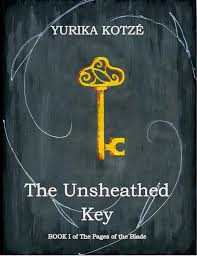
imgres-2 Yurika Kotzé is a fantasy author and wildlife researcher. She loves history and combines the inspiration she gleans from living in Africa with medieval swords and water nymphs – because, well, why not? Her first novel, The Unsheathed Key is now available as an ebook from Barnes&Noble, Kobo and others. Check out her website for info; or to read an excerpt.

 ————————————————————————————————————-     So there we were, sitting next to the fire on our farm, right on the border of Zimbabwe. We were happily nibbling away at our chops and tossing the bones into the fire, when another sound suddenly rose above the rushing waters of the river. A deep sawing noise.

Steady and rhythmic, it grew in volume and started to move around our campfire, just out of sight. If there had been any doubt, the sour feline smell confirmed it: we were being stalked by a leopard.

Nervously, we jumped up and put our backs to each other. My husband, his friend and I formed a little tripod of comfort as we steadily made our way to the car, eyes peeled for movement. The leopard sawed and barked and growled as it circled us, completely focussed on its prey. My hand finally found the car door’s handle, but it was locked. Laughing nervously, my husband fumbled for the keys as our friend loaded the .375 rifle.

At last, I managed to unlock the car with my shaky hands and the three of us piled into the front seat. We hastily shut the door and finally caught a glimpse of the leopard as he made his way back into the bush. We burst out laughing.

I am proudly South African. Moments like these make me fall in love with this beautiful country. Growing up just outside of the Kruger National Park and later living on an elephant farm, I have had my share of encounters.

images-1Being exposed to raw, unbridled Africa changes you. There is an atmosphere here that can only be understood by those who have experienced it.  It’s the perfect place for any fantasy author to become inspired.

South Africa is the birth-place of Tolkien and his Middle Earth, and there is nothing like hiking the Hogsback Mountains and seeing the world through his eyes. It’s also the perfect place to read The Hobbit. Except when your dog comes running out at you out of nowhere while your head is filled with orcs… I have never screamed so loud.

As a writer, I need to draw upon my surroundings, write what I know; and I am spoiled for choice. ‘Upside-down trees’ (baobabs), magnificent animals, folklore, and mighty rivers… I have been stalked, chased and burnt to shreds by the African sun enough for me to have writing material for years to come.

imgres-1I love this continent.

 —————————————————————————————————————-

Yurika Kotzé is the author of The Unsheathed Key. Check out her website for more information or to read an excerpt.

imgres-6

Gotta Love Terry Brooks

Just two weeks ago, I whined in Elves, Dwarves and Political Activists about being embarrassed that I write about elves, that people won’t take me seriously when I say I want to influence the values of the next generation, something I wrote about when I first started along this path back in 2011.

It’s nice to know that I am not alone in having to justify why I love to write about elves and dwarves. Terry Brooks, one of the greatest epic fantasy authors, has been facing these questions for over 30 years. You would think, given that he is a bestselling author, that people would cut him some slack.

 terry-brooks-150x150

But Mr. Brooks is the ideal person to deal with this, because he is…well he is…simply a mensch as I mentioned only a few months ago.

Grab yourself a cup of joe and sit back. Here in 15 minutes, he provides his answer, with a smile, a joke, and the confidence of one who is a master of his craft. Best of all, he does it with such humility and modesty.

 Gotta love Terry Brooks!

Enjoy the Solstice, everyone. From tomorrow we can now greet each other with Winter is Coming!

—————————————————————————————————–

Alon Shalev writes social justice-themed novels and YA epic fantasy. He swears there is a connection. His latest books include: Unwanted Heroes and the 2013 Eric Hoffer Book Award for YA – At The Walls Of Galbrieth. Alon tweets at @alonshalevsf and @elfwriter.   For more about the author, check out his website.

The Gods of Fantasy

Pass a summer evening in a quaint English pub, mid 20th century, perhaps in the old town of Oxford. Caress a pint and listening to a few graying professors discuss semantics, philosophy, and the ancient languages long forgotten outside the sheltered walls of academia. What else can one possibly ask for? 

imgres-1Imagine these tweed-clad, pipe-smoking academics, hatching more than another challenging semester to try the greatest minds of this fair isle. Each is a king in the making or, more accurately, a kingmaker. For they direct more than the destiny of kings and noble houses. They raise kingdoms and conquer lands. They build great dynasties, bring whole species back from the mists of extinction, and set those of noble birth and principle to stand against evil.

Sip your beer, mull over the words, much of which you might not understand. Dwarves, elves, of course: but hobbits? Marsh-wiggles? Listen as the professors strategize great battles, masterfully marshalling unicorns, dragons, giants, minotaurs and proud ents. 

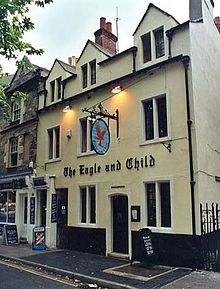
You slowly realize that you sit among the Gods, the creators of Middle Earth and Narnia, who hold court on Tuesdays at midday in a local public house. Perhaps it is The Eagle and Child, or The Lamb and Flag across the street. They read each other’s work and offer critique as writer’s groups have for centuries and continue to do so today.

220px-Birdandbaby 

I may never have understood much or been accepted into such an elite. They would have torn my work to shreds on grounds of philological shallowness (I had it checked – it’s not contagious), criticized me for imprudently suggesting that a 100,000 word novel can serve as more than merely an introduction.

They would have demanded richer world-building – take twenty pages to describe a forest, I dare you – unyielding heroes, and infallible plots. They would have challenged the age-old legends dressed up in fictional costumes, and raised an eyebrow at some of the language or innuendos.

Most likely, I would never have dared reveal my stories to the old professors of Oxford, to the most famous writing group in history. I would never have been more than a fly on the wall at a meeting of The Inklings, but would have returned week after week to sit at the feet of the Gods and hear their banter.

For here the Gods gave birth to great worlds and left them as a legacy to us and to our children, long after they departed this world. Every Wednesday night, I sit around a table in a coffee shop in Berkeley, sharing work with other aspiring authors and wonder: do the Gods look down upon us from Writers Heaven?

 lewis-and-tolkien1

Do they tut and shake their heads at our adverb addiction, our unwillingness to kill our darlings? Or do they even now move pieces around the literary chessboard? Protect the king! Advance the knights! Who, I wonder, are the pawns?

As we write a new book, a new chapter, do we not imagine the Gods walk among us?  Do they peer over our shoulders at our swanky writing machines, judging every word we write, every world we build? 

The Gods once sat in an old English pub. Now they stand behind us in coffee shops and at kitchen tables, urging us on, watching us walk the path they forged, taking on the quest they started.

For the Gods still walk among us and inside of us. The stories have been told but must be told again in different ways to a different generation. We sign these books in our own names, but humbly acknowledge those who molded us in their image as storytellers.

And now they are the flies on the wall and we who pound the keyboards. Take a moment, draw another pint, and raise your glass:

To the Gods of Fantasy!

—————————————————————————————————–

Alon Shalev writes social justice-themed novels and YA epic fantasy. He swears there is a connection. His latest books include: Unwanted Heroes and the 2013 Eric Hoffer Book Award for YA – At The Walls Of Galbrieth. Alon tweets at @alonshalevsf and @elfwriter.   For more about the author, check out his website.


The Fellowship of the Book

All our protagonists had them – a fellowship of loyal followers and friends, ready to put their lives on the line, to draw their swords in defense of the hero/ine, and to go off on dangerous missions or to pass on an important message.

hobbits in pub

What would we do without them? How would our characters cope bereft of true companionship? I have mentioned in the past the lure of universal values to the conventions of epic fantasy. We long to lose ourselves in some far off land, discover mythical creatures, embark on a noble quest.

Granted, but we also seek values that are part of our everyday aspirations: justice, truth, love, riches … and friendship.

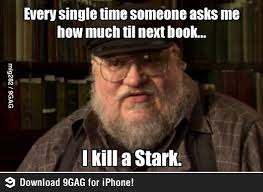
Why am I writing about this? Last week, I somewhat frivolously criticized George R.R. Martin, author of the Game of Thrones series. I learned two things from the experience:

1) Mess with a great epic fantasy author if you want to boost the hits to your blog.

2) Mess with the followers of a great epic fantasy author at your peril.

images-1

My humble offering garnered 4-5 times the amount of hits of an average blog post (not that any of my posts are average, of course) and I received far more comments, many of which were retweeted and favored on twitter, some, I admit, by myself.

To those who accused me, a humble fantasy author, of being insanely jealous: I accept the charge.

To those who say people who criticize Martin’s long tomes suffer a short attention span, I say – next point.

And so it went on. To be fair, there were many who agreed with my pointed digs, and in the name of credibility, still faithfully open the next book in the series. I myself, despite honorable intentions to take a break having just concluded Book 4, read Sacre Bleu, the latest by one of my favorite authors, Christopher Moore, and having finished it, promptly started Book 5 – A Dance of Dragons.

imgres-2

What is clear is that, in the same way that we want to align ourselves to great fictional characters, we subconsciously swear fealty to their creators: the authors. I encountered fans of Mr. Martin, as loyal as Frodo’s gardener (well maybe not quite). They were ready to defend him to the hilt – even if they privately knew I was right. It is something very special about the people attracted to the genre.

The skeptical among them would probably accuse me again of jealousy: that I crave one day to have Wycaan Master followers as loyal as them. To my accusers I proudly say: Yeah. Darn right!

Have a great weekend,

Elfwriter

—————————————————————————————————–

Alon Shalev writes social justice-themed novels and YA epic fantasy. He swears there is a connection. His latest books include: Unwanted Heroes and At The Walls Of Galbrieth. Alon tweets at @alonshalevsf and @elfwriter.  


A Private Letter to George R.R. Martin

Dear Mr. Martin,

Let me begin by saying that I am a big fan. I have just finished Book 4 and, if that isn’t proof enough, I am preparing to read Book 5. I have sung your praises on my humble elfwriter blog and keep your photo under my pillow (I don’t – but I wanted to make sure I still had your attention).

It’s like this, sir. One day I want to be a bestselling epic fantasy author like you. My third book comes out in the fall and I have probably sold as many books as you’ve killed noble characters (actually I might be being a bit optimistic there).

images-3

I spend a lot of time hanging out with other writers: online and (I know this is rare) actually in person. Everyone tells me to “observe the rules,” “don’t break the conventions,” and, my favorite, “Tolkien was one-of-a-kind. You wouldn’t get away with that.”

But you, sir, have broken the rules. You have tippexed (anyone?) over the conventions. One friend suggested that you only get away with it because you are already famous, already have a huge following, and probably don’t care anymore what anyone outside of the Seven Kingdoms thinks.

images-1

So here is my list of 10 things you have done wrong:

1. Your books are too long. I keep getting told that 90K is way beyond the commitment that most readers are willing to invest today. But then why do I enjoy them (and Christopher Paolini, and J.K Rowling, and some unknown ancient language, Oxford professor) and feel a sense of loss when they are finished? 

2. Your books are too slow. People want action, action, action. Instant gratification …debate in 140 characters or less. Have a car chase or blow up a bridge – well, you get my point.

3. Your books are too detailed. You mean I need to think? Concentrate? Invest? I hear you keep flow charts in your office – can we peek? How about a deal with Cliff Notes or an app that you can enter a character, your book and page number and get an update. Dude – I totally expect a commission on the app idea.

4. Your characters are too flawed (especially the good ones). If I’m not seeing Ryan Gosling or Kristen Stewart then it simply won’t do. If I want real people, I would put my book down and hit the pub.

images-2

5. Your characters are too dead. I actually wrote a blog post about this (I Need A Hero), keeping the book and you anonymous so as not to spoil it. Guess what? Everyone knew who I was talking about.

6. You drop some characters for hundreds of pages – are you tempting me to skip pages, sir? Just so as not to spoil this for any readers on Books 1-4, you know what I mean when I connect this to Book 4//5.

7. You miss out key scenes – battles in particular – and subtly let us know they have happened. I know it is incredibly difficult to write battles and only the best can pull it off, but well sir, you are one of the best.

8. You have too many minor characters. I hope you are keeping track of them because, to be honest, I am developing a habit of scratching my head whenever someone resurfaces 1-2,000 pages later.

9. You care more for the old gods and the new than the critics.

10. Your books are too addictive. I can’t stop…

You broke all the rules, sir. Congratulations! Now where is my copy of Book Five?

images

—————————————————————————————————–

Alon Shalev writes social justice-themed novels and YA epic fantasy. He swears there is a connection. His latest books include: Unwanted Heroes and At The Walls Of Galbrieth. Alon tweets at @alonshalevsf and @elfwriter.  

.


Being A Bestseller, Being A Mensch

The majority of this post has come from an account by a non-fantasy reader, One Ill Writer,  who happened upon a book signing of Terry Brooks in August 2011.

I have been looking of a way to recognize Brooks, whose first novel, Sword of Shannara,  will soon celebrate its 30th anniversary. I have personally finished three of his trilogies and I am, one would say, indeed a fan.

“This past Thursday, some friends and I went and checked out Terry Brooks at the Cedar Hills Crossing Powell’s Books. I had read one of his books back in the late 80′s. He writes elf magic fantasy novels mostly, which aren’t really my thing, but I’m always interested in hearing what an experienced novelist has to say regardless of genre.

“My favorite thing about genre fiction is that the fans are dedicated to their favorite authors. And let me just add here that Terry Brooks’ fans are fanatics. I love that. There’s something infectious about people being so in love with an author’s world that they squirm with unrestrained giddiness and exchange obscure trivia about the different books set in that universe. I didn’t know much about Terry Brooks or his novels, but within five minutes of sitting down, I was pumped for I didn’t know what.

“In all about 60 people sat in folding chairs and stood around the edges. There was a guy a row ahead of me who had a duffle bag full of all the Brooks novels in paperback. An employee from the store was handing out post-its so Terry would spell your name right when he personalized your book.

“There was a rolling rack full of dozens of copies of his latest novel and a few people grabbed a copy before they sat down. There was a microphone at a podium behind which was propped a large poster of the new book cover. To the right of that, a table with pens on it. Pretty standard book release/signing setup. I’ve been to a few of these things and sometimes the authors come out, they read, they answer a few questions (one of which is invariably, “Where do you get your ideas?”), then they sign books. The author’s demeanor at these things normally ranges from contemptuous to putting-on-a-good-face.

“But Terry Brooks has been in this business a long time. When he came out, he said hello and from that instant, he was in 100% control of his fans. He said he would read a few pages from a book, but instead of the book being released, he would read from the next, unpublished book. He then said he would make an announcement about upcoming works that he hadn’t even told his publisher.

“Lastly, he said he was going to release a book every sixth months instead of once a year. If you think the crowd was excited when they showed up, after these three statements, people were losing their minds. It wasn’t like they were cheering and screaming like a drunk at a soccer match, but they were exchanging looks and shifting in their seats. If there’s one thing about fans and collectors, they love knowing something before anyone else. And more than that, they love to be the ones who tell their friends who didn’t make it to the reading! More than one person was using their phone get video of the announcements.

“Mr. Brooks understands his readers. Maybe better than any novelist I’ve seen speak. When the Q&A came, he didn’t laugh or scoff at the obscurity of any of the questions. And he answered every question quickly with engaging humor and honesty. I couldn’t tell if he actually had his whole universe in his head, or was just making stuff up on the fly, but either way, every fan was satisfied with his answers. He never dismissed anyone or said anything like, “What do you think should happen?” It was amazing. I won’t even go into the pages he read, but I’ll sum up by saying the reading ended with a cliffhanger. I read one book 20 years ago and suddenly I can’t wait for the next one? Brilliant. The guy was a master of his element.

“What I took from this besides an admiration for the professionalism of Terry Brooks was that it’s crucial to know your audience. Crucial! He writes books that he knows his audience will love. He’s not writing to a general fantasy market, but specifically to those who already read his books. John Locke, the million-selling ebook guy, said the same thing. Guys like them know they will ultimately sell more books because their hardcore fans will be a marketing army. For FREE.

“I had noticed he pronounced “Shannara” (his universe) differently than all his fans did. He said “Shanneruh” while everyone else says, “Shuh-nara.” You know, sounds more elf-y that way. So I asked him if he ever got into arguments with fans who pronounce things differently than he does. He said, “No, man. It’s your book. Say it how you want.” People behind me in line laughed. Flawless. Now it’s MY book!

“The number of books he sold that night was astounding. People who had casually picked up a used paperback before he spoke had stacks of books by the time they got in line for the signing. The new release rack was nearly empty when I left. He had converted everyone in the room. He reminded his die hard fans why they read his books. If said before that the energy of the fans was infectious, Terry Brooks’ respect for his fans was doubly so.

“People who aren’t sci fi or crime or fantasy dorks don’t get it. Book nerds are weird people, they think. They also think it’s ok to dress head to toe in Timbers or Seahawks colors and get hammered in the nosebleed seats on game night, but not ok to take an armload of books to the suburbs and actually shake the hand of the man who enriched your life for the past 30 years? Give me the book nerds any day.”

I love this account because it comes from someone outside the genre. Brooks endears himself to people because he is both a master of his craft and a humble person. That’s a rare blend for a 21st Century celebrity. It feels almost mythical, even other-worldly.

——————————————————————————————————

Alon Shalev writes social justice-themed novels and YA epic fantasy. He swears there is a connection. His latest books include: Unwanted Heroes and The First Decree, the sequel to At The Walls Of Galbrieth. Alon tweets at @alonshalevsf and @elfwriter.  

.

Why Epic Fantasy Can Be So Profound

The Lord of the Rings is a story (or several stories) about elves and dwarves and dragons and quests. And yet, professors sit in their Ivy League towers and dig deep into the story, seeking meaning, analyzing plot and characters, symbolism and analogy.

Grown men and women who read the books 20 or 30 years ago, continue to debate the values and meaning, while counting down the days from one epic movie to another. We reverently pass on the books, DVD’s and walk our children to the movies – a sacred rite of passage.

Here is a documentary that not only analyzes these aspects through a variety of knowledgable men and women with delightful accents, but also the symbiotic relationship between Tolkien with C.S. Lewis. Both men’s motivations and writing, for example, were shaped through their experiences in World War 1. They went on to create two of the greatest epic fantasy series ever. It is thirty minutes that are well worth the time.

lewis-and-tolkien1

So please, grab yourself a mug of ale, light up the Longbottom leaf, and enjoy a revealing explanation of a unique man who blazed a path for so many who came after him.

As one who owes him so much, I am truly humbled.

One last point: if you have the energy,  browse through the comments under the You Tube video. It is amazing how many people had such difficulty reading the LOTR and yet still have a deep appreciation for the work.

——————————————————————————————————

Alon Shalev is the author of the 2013 Eric Hoffer YA Book Award winner, At The Walls of Galbrieth, and five other Wycaan Master books all released by Tourmaline Books. The link above takes you to the Kindle versions. For all other eReaders, please click here.

More at http://www.alonshalev.com and on Twitter (@elfwriter).