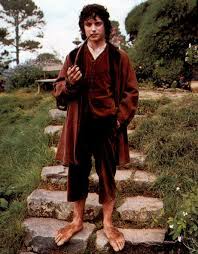
The Hobbit: End of a Father’s Era

I admit it. I haven’t felt like this since the end of Harry Potter movie 7.2. I remember sitting in the movie theater watching the credits rolling and hoping for a hint that there was another series on the way. Anything to keep the dream alive.

But the credits ended, the lights came on and I looked at the two boys who had snuggled up to me for eight years as Harry and co. had bespelled us, binding us together in an intense family experience.

I comforted myself. At least there were the Tolkien movies: The Lord of the Rings offered three years of reprise and then, The Hobbit, that thin novella, sprouted into three movies over three years. No problem with me that most of the movie content came from other books – Tolkien purist that I consider myself. A female elf (an elfe in the Wycaan Master series): a warrior at that? Bring her on.

 hobbit-evangeline-lilly

And now, my boys and I, one taller than me and shaving, will walk the lonely steps to the shrine of moving pictures, to pay homage one last time to the Old Professor’ world on screen. But at least we walk together, sit together, crunch popcorn together…

And I know that the lights will come on and, after six Middle Earth movies, we will stretch our limbs (some considerably longer than they were six years ago), and then what?
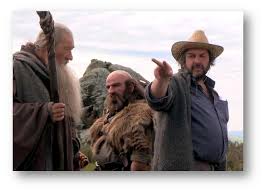
imgres-1

Last year I was proud when my then 15-year-old told his friends that he would not join them to see the Hobbit movie – its one he’ll see with his old man. I might not be the best father in the world, far from it I’m sure, but I figure I must have done something right.

Worse yet, in ten days I will complete the first draft of Book 6 in the Wycaan Master series. I remember writing the first novel together, a half decade ago, with two eager boys sitting around a picnic table in a redwood forest. For five more years, I would read a new manuscript to them each summer vacation around the campfire or snuggled in my tent. It ends this year … the Wycaan Master series that is essentially ours …and probably so much more.

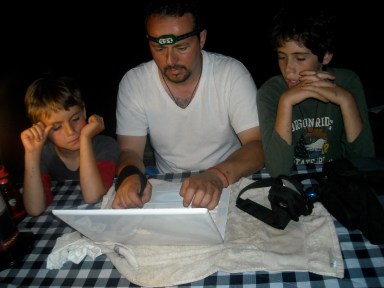
This is how it all began - deep in a redwood forest.

There will be more novels, perhaps another trilogy (are you reading this, Tourmaline Books?), but there will be new characters and if I stay true to my sons, then they will be older and darker and all grown up.

Just like my sons – post Harry Potter and post-Tolkien. The end of an era.

——————————————————————————————————

Alon Shalev is the author of the 2013 Eric Hoffer YA Book Award winner, At The Walls of Galbrieth, and five other Wycaan Master books all released by Tourmaline Books. The link above takes you to the Kindle versions. For all other eReaders, please click here.

More at http://www.alonshalev.com and on Twitter (@elfwriter).
 

Deeper than a Joke

There is a joke going round the Internet:

A teenager visits his uncle and is impressed to see the older man’s den is decked out with epic fantasy memorabilia. There are boxed figures of elves and dwarves, swords on walls, a couple of helmets and more. The boy walks along a wall lined with complete book collections of every greatest series.

images-8

He abruptly stops. “Uncle, you have so many books from every famous author, but you are missing books from the biggest of them all?”

His uncle looked up surprised. “Tolkien?” he said. “Of course I have them all.”

“No,” his nephew persisted. “You only have the first Hobbit book. There are three.”

Now to be clear: I love the Peter Jackson movies, every one of them, and can’t wait to go this week to the final Hobbit movie. I have just lovingly brought my eldest son and wife up to date on the fourth series of Game of Thrones, the TV series, even though they both languish in reading Book 1. I am one of the 15,000 who signed the famous petition demanding a third Sword of Truth series from ABC and, just between us, mourn that Christopher Paolini’s Inheritance series never spawned more than one movie.

images-9

Having said this, I do wonder whether we are nurturing a generation who are defining epic fantasy based upon the movie, rather than the book. When we watched the final episode of the fourth Game of Thrones series, something happened that was hinted about throughout the books (please no spoilers in the comments). Yet both my wife and son were perplexed, because the movies/TV series is never going to be able to capture the intricacies and subtleties.

This week, we became a three-eReader family. It was a big decision, but an acceptance of the times. If I want my sons to read books, I need to bring them in a medium they expect – on screens.

My Wycaan Master series, which, I assume, is read mostly by young adults, continues to sell far more ebooks rather than tree books. My eldest is excited to see the Maze Runner movie, having loved reading the books. That is, I feel, how it should be.

photo (17)

But I also know that a new generation of Tolkien troopers, Goodkind groupies, and Dashner disciples, will grow up basing their experiences on the movies…and I can’t help feeling there is something missing.

Have a great week – enjoy the final Hobbit movie.

imgres-2

————————————————————————————————

Alon Shalev is the author of the 2013 Eric Hoffer YA Book Award winner, At The Walls of Galbrieth, The First Decree, and Ashbar – Wycaan Master Book 3 – all released by Tourmaline Books. His latest novel is Sacrificial Flame, the fourth in the series.

Shalev is also the author of three social justice-themed novels including Unwanted Heroes. He swears there is a connection. More at http://www.alonshalev.com and on Twitter (@elfwriter). Hang out with Alon on Google+


Walking Away From A Fantasy Series

I have heard others talk about the difficulty of finishing writing a series, of tying up loose ends, of sad partings and death, glorious battles and victories. However clear your plot line is, it is difficult to turn your back on characters who have walked with you on the paths of fiction for five or ten years.

When I finished the first draft of Book Five during the summer, the plan had been to edit and rewrite and then send out to my editor by the end of October. What actually happened was that I plunged straight into Book 6 and now, three months later, I am writing the final third of the book: the climax and end of the series. My publisher knows that a February launch date is mere fantasy (excuse the pun), but given that they are more used to authors who get writers block and stop writing, my uncontrollable urge to write is hardly seen as much of a disaster.

Leonid_Pasternak_001

However, I am finding the final third of Book 6 so difficult to write and it is a strange feeling. There are many storylines to tie up and it occurs to me that perhaps it is better to write the sixth book before locking down the fifth.

The conclusion of a series is a huge responsibility and radically different from finishing one novel. There are many reasons why a series is easier than individual standalone stories and many reasons why it is harder.

But beyond anything, and first and foremost is the multiple strands of plot, is the commitment between author and character, and this truly weighs me down. I have written before about killing off characters but even dead they remain part of the story.

I hope to finish the first draft of Book 6 by the end of the year. Thirty thousand words in forty-five days with Thanksgiving and the Christmas holiday season included is not daunting in terms of output. But this time it feels different and a steeper mountain to climb.

I am wondering if other authors feel the same way? The Professor went on after Lord of the Rings to write two more tomes, though George R.R. Martin seems relieved to soon finish. How do you feel, a reader or writer of series’, when you approach the end of an era?

images-1

Enough pontificating. another 30,000 words to write!

———————————————————————————————

Alon Shalev is the author of the 2013 Eric Hoffer YA Book Award winner, At The Walls of GalbriethThe First Decree, and Ashbar – Wycaan Master Book 3 – all released by Tourmaline Books. His latest novel is Sacrificial Flame, the fourth in the series.

Shalev is also the author of three social justice-themed novels including Unwanted Heroes. He swears there is a connection. More at http://www.alonshalev.com and on Twitter (@elfwriter). Hang out with Alon on Google+

Happy Hobbit Day!

To celebrate Hobbit Day tomorrow (the birthdays of both Bilbo and Frodo), I would like to share a post I wrote two years ago after the first Hobbit movie came out. There is so much depth in the Hobbits’ simple characters, especially in relation to the others around them – wizards, kings, princes, elf lords etc., that it is an amazing tribute to Tolkien how he weaved these unassuming and lovable creatures into our psyches. This was my tribute to the old professor after the movie. 

Happy Hobbit Day!

THERE ARE NO SPOILERS ABOUT THE MOVIE IN THIS POST.

Last week I blogged about my expectation that a new generation were about to embark on an unexpected journey into the world of epic fantasy as they sat and watched the first Hobbit movie.

I mentioned with pride how my teenage son, moving into social independence, chose to see the movie with me rather than his friends. My first fantasy novel (and the three others to a lesser extent), At The Walls Of Galbrieth, was a joint project, and I identify our mutual love for the genre as one more log to grab as he flows down the river of manhood.

DSCN0193

We sat next to each other and whispered and compared experiences. It was everything a father could hope for.

But it was with my youngest son (10 years old) with whom I had an unexpected experience. I wish to thank the movie theatre for failing to fix the armrest between us (why does this never happen on a date?). We were able to push it up and out of the way and for three hours, we cuddled together as we watched the movie.

While my older son leaned over and whispered whenever he wanted to, I could actually feel my youngest son’s reaction by his body language. I was intrigued. I felt when he tensed, when he was amazed, when he was sad, and when he laughed.

Other people - didn't think my fellow movie-goers would appreciate the flash!

Other people – I didn’t think my fellow movie-goers would appreciate the camera flash in the middle of the movie!

As we made our way home after the movie, my youngest enthusiastically told me about how we should incorporate this or that into the fourth Wycaan Master novel. I think the Tolkien Estate might sue if we did what he was suggesting, but for the moment, I just basked in his enthusiasm.

Another epic fantasy lover. I’m not the greatest father, I know. But this evening I felt I had done my job.

Finally a shout out to Stephen Colbert. Depending on your politics, you may or may not enjoy his nightly show. But he is undoubtedly impressive with his ability to be satirical and hold his own with very high-level guests.

But he outdid himself with a week of tribute to The Hobbit. Turns out, Mr. Colbert is a major Tolkien fan. His elfish sounds polished, and his knowledge of The Professor’s work is awesome.

Colbert and Sir Ian McKellen (Gandalf)

Colbert and Sir Ian McKellen (Gandalf)

Check him out on You Tube – he has a different cast member as guest each night.

——————————————————————————————————

Alon Shalev is the author of At The Walls of Galbrieth, Book 1 of The Wyccan Master series, which reached the Quarter Finals of the Amazon Breakthrough Novel Award 2012, released by Tourmaline Books. The First Decree, the sequel is due out in early 2013. Shalev is also the author of three social justice-themed novels: Unwanted Heroes, The Accidental Activist and A Gardener’s Tale. More on Alon Shalev at http://www.alonshalev.com and on Twitter (@elfwriter).

The Power of the Bow

There is a children’s movie just come out, Brave, with the heroine sporting a bow and arrow. Katnis, from the Hunger Games, was lethal with one. Legolas was extremely handsome even in the midst of a desperate fight for Helm’s Deep and never missed when he let fly.

It seems that a bow and arrow are integral ingredients in fantasy, even when the setting is modern enough for guns and technology. Bows were, of course, around before fantasy. Who can forget Robin Hood in the archery contest splitting his opponent’s arrow, which had pieced the center of the bull’s-eye? Classic.

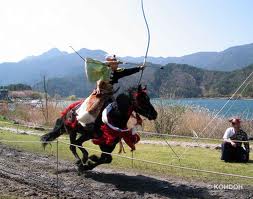
And then there are the Samurai with their beautiful longbow, the Yumi. They didn’t just shoot it with their distinctive technique, but held a philosophical discipline, kyūjutsu, akin to Tai Chi and other spiritual martial arts.

Even after the bow became outdated as an effective weapon it remained a form of training for its warrior code value. The yumi was also fired from horseback because of its asymmetric shape and this practice evolved into a Shinto ceremony known as yabusame. At the risk of sounding trite, there is a beautiful scene in The Last Samurai, with the yumi being explained and fired.

In the West we have also been drawn to the spiritual values of the bow. Eugen Herrigel’s classic, Zen in the Art of Archery, is still a classic fifty years after he wrote it. My 13-year-old has become obsessed with archery. He made his own bow and learned how to shoot it from a teacher. He takes classes at camp and has spent over a year saving up to buy a ‘real’ bow. When I wrote two scenes in the third Wycaan Master book, he provided me with a lot of excellent and rich information. 

I’m still struggling with why the bow is so captivating. For some reason, I am not questioning the sword in the same way. Use of the sword is elegant, noble and also has numerous philosophies and katot (martial art form), but there is something that sets the bow apart and keeps us coming back for more.

 Any ideas? Please share in the comments below.

——————————————————————————————————

Alon Shalev is the author of the 2013 Eric Hoffer YA Book Award winner, At The Walls of Galbrieth, and five other Wycaan Master books all released by Tourmaline Books. The link above takes you to the Kindle versions. For all other eReaders, please click here.

More at http://www.alonshalev.com and on Twitter (@elfwriter).
Will My Stories Be My Legacy?

This post is dedicated to a dear friend and poet, Al Levinson, who just passed away after a long struggle with cancer, refusing to compromise on his retirement dream as he traveled around America in his old RV. Al was a constant source of encouragement and support for many, myself included. His belief in my vision provided a consistent source of strength when my proverbial quill went dry or my doubts threatened to drown me.

——————– 

I wonder if the ‘Old Professor’ looks down from his study in the skies as people continue to fall in love with Middle Earth, with his elves and dwarves, his noble humans, and of course, his brave and lovable hobbits. What does he think as he puffs on his pipe and stares from the heavens at the people who annually watch his trilogy of Lord of the Rings, and who attend conventions to argue nuances of hobbit genealogy? Is he baffled that the quartet of geniuses from The Big Bang Theory is so in awe of him? (I just watched, perhaps for the sixth time, the episode with the ring … excuse me – The Ring).
imgres-1                                                         imgres-2                                             images-1

I recently met a young man who is, I think 11 or 12 years old. He has read the first three novels of the Wycaan Master series, and his first question was when Sacrificial Flame would be released. He then proceeded to tell me what he thought should be in the book, sharing stunning detail from the first trilogy. I probably sounded like a bumbling fool to him and his mother, but in truth, I was reeling from the astounding grasp this young man has on the geography of Odessiya, of the culture of each race (he knew in his mind exactly what a pictorian looks like – I don’t), and the trials and tribulations they have gone through, including so many minor threads.

The fusion of my family’s summer ritual to watch the Lord of the Rings and now The Hobbit, the passing of my friend Al, me turning fifty, and hearing this young man’s enthusiasm, awakened in me a desire to create a legacy, not only as a conscientious soul mate and father, a decent human being, and a good friend to all, but absurdly, that my characters will not go to the grave with me.

Perhaps it is a symptom of my acknowledgement of my own finiteness, having just turned fifty this summer, but there has emerged a powerful aspect of my writing: that I am creating something that will outlive me, and perhaps in the eyes of future generations, define me. Will my stories become my legacy?

Professor Tolkien might, at best, be bemused at the desire of grown men and women to dress up as Arwen and Legalos, Bilbo and Gollum at every excuse, or while he might scratch his head when we vigorously argue the merits of including a (formally nonexistent) female character being invented for The Hobbit movie. But I wonder does his chest swell up with pride when his grandchildren and great-grandchildren, proudly hold his books and tell their friends that “Tolkien was my grandfather”?

imgres-3           images-3                                    1images-2

I can’t speak for the ‘old professor’, but I hope one day to peer down through the clouds and see my grown sons, sitting around the camp fire with their offspring as we do each summer, telling the stories of Seanchai and Shayth, Mharina and Senzia. As their children yawn, struggling to stay awake, and beg for just one more chapter, my sons will close the book and say: “Let me tell you about the storyteller. He was your grandfather and I helped him write these stories…”

——————–  

Rest in peace, Al. We are many who were touched by your kindness and will carry your inspiring torch forward for future generations. I hope that, as you look down from the heavens, you see this as your legacy.

10556500_10204400080432565_3898203193364948967_n

Al Levinson RIP

—————————————————————————————————

Alon Shalev is the author of the 2013 Eric Hoffer YA Book Award winner, At The Walls of GalbriethThe First Decree, and Ashbar – Wycaan Master Book 3 – all released by Tourmaline Books. His latest novel is Sacrificial Flame, the fourth in the series. Shalev is also the author of three social justice-themed novels including Unwanted Heroes. He swears there is a connection. More at http://www.alonshalev.com and on Twitter (@elfwriter). Hang out with Alon on Google+

The Empowering Stereotypical Female Protagonist

 Two weeks ago, I wrote a blog post about the sappy male hero, the protagonist who is can be brave without being too macho and who is in touch with his values and feelings. The post generated considerable discussion and debate, and since I am in the appreciating mood, thank you for your feedback.

But it also got me thinking about my female protagonists. With well over 70% of readers apparently girls and women, it would seem daft to ignore them. In truth, my inspiration for strong female characters comes from less altruistic motives. I am blessed to have been surrounded with strong women all my life, none more so than Mrs. Elfwriter, who continues after two decades together, to amaze me with her strength, vision and principles. I have come through a tough summer and she has been my rock throughout.

Sacrificial_Flame_Cover_Hi_Res.205201213_std

Yesterday, a dear friend told me that it would have been his and his deceased wife’s 25th wedding anniversary, had she not succumbed to cancer a few years ago. My mind reeled back to her struggle, to the elegance with which she continued, right up to the end, to be a source of strength and inspiration, to her family and friends.

These thoughts are relevant to my female protagonists because I realize that I am creating similar (albeit female) stereotypes of common heroes and heroines. Ilana, Sellia, Mhari, Pyre and Mharina are all brave warriors. Fearsome with bow or sword, they might seek to solve a conflict without resorting to violence (as Seanchai did, to be fair), but nonetheless are not females you would want to pick a bar fight with (not that you are that kind of person, of course).

 keira_knightley2

When I began this post, a couple of days ago, I had hoped to pat myself on the back for my strong female characters. In Sacrificial Flame there is almost an absence of strong males (unless they are evil antagonists). In Book 5 (sorry for the tease) there emerged two males who are not warrior-types. As I begin writing Book 6, I realize that I have not given them much space in my initial plan. I will address this. Likewise, I have not given thought to the non-warrior, strong female protagonist.

Do any strong female protagonists who are not warrior-type come to mind from your reading of epic fantasy? Is it even compelling to have female who is not beautiful, thin, brave, and wicked with sword or bow? Would love to hear.

 imgres

Have a great week. Read something epic!

——————————————————————————————————

Alon Shalev is the author of the 2013 Eric Hoffer YA Book Award winner, At The Walls of Galbrieth, and five other Wycaan Master books all released by Tourmaline Books. The link above takes you to the Kindle versions. For all other eReaders, please click here.

More at http://www.alonshalev.com and on Twitter (@elfwriter).

The Sappy (Male) Hero

As I mentioned last week, I am work-shopping a magical realism novel to my fearless writer’s group. I was worried how they would react to the more graphic violence and the explicit sex that is a far cry from the YA epic fantasy novels I have shared over the past few years.

35493_1314936000

Song of Battlefield by Norry at Epilogue

But this week, a couple of the participants surprised me. They suggested that perhaps my protagonist is too in touch with his feelings, that he is too sappy in his budding relationship with the sassy, but attractive Brynn.

The protagonist, the Kingfisher, has experienced many traumas, including the destruction of his country and family, for which he feels responsible. This looming sense of failure follows him as he begins to tread a similar path in Cassia, while searching for his sons, who have been sold into slavery.

“How is it,” one of my readers asked, “that one minute he can be ruthless and violent with his enemies, and then so tender with those close to him?”

“How can he,” another asks, “be so traumatized, yet so self-aware?”

I am puzzled by this, not least because if the Kingfisher was female, I suspect we would not be asking such questions. It feels (on a totally different level of awareness, I know) similar to hearing political pundits wonder whether Hillary Clinton can function both as President of the United States and as a grandmother. No one asks this of her male predecessors. Apparently one can be a President and grandfather, though judging by some of their performances, I am left wondering…

I work hard to present my characters as multi-dimensional. This summer, I began the indoctrination of my family (not the protesting youngest) with Game of Thrones. Mrs. Bloggs (she should actually be addressed now as Dr. Bloggs) pointed out that there is only one (royal) character in George R.R. Martin’s thousand-character cast, who it is easy to thoroughly hate. No spoilers, however!

images-1

I have written previously of my admiration of Martin’s ability to make us care for his characters while blatantly exposing us to their flaws.

Most people in real life are both good and bad. It is the endless struggle wherein we strive to make ourselves better human beings (or not), and we are, by and large, inconsistent. There are days when we are heroes and others we are embarrassed about.

Fantasy is all about showing the reality of human behavior in a different concept, fiction allowing us to bend the story to suit our plot. Nonetheless, fantasy (and most genres of fiction) stand and fall on the reader’s ability to connect: with the plot, characters, and conflict.

I lived for two decades in a country where all eighteen year olds are conscripted and many serve in combat units and see real action. It never ceased to surprise me to discover that a gentle father was an officer in an elite unit, or that a mild-mannered man was a sniper, holding life and death between his sights. I see it in other people’s expressions when I talk of my own experiences.

Perhaps the issue that my readers are experiencing with the Kingfisher, is that we are hearing him speak and think in the first person. We are literally inside his head and this might be why so many feel his introspection is so jarring. We feel his pain, his rage, his love, and his conflict.

Most men can hide their fears in the privacy of their bedrooms, their cars, or their empty bottles. We don’t need, or are expected, to express our inner emotions and vulnerabilities, in public. And if we do, perhaps we are scorned for being sappy and in touch with ourselves.

Perhaps this is why we need fiction: to show the human side of half the world’s population, when the world is not ready to see it in reality.

Sacrificial Flame – Update on Book Launch

The review copy arrived this week. Unfortunately there was an error of placement of the book cover and there is at least another week’s delay. I understand why Tourmaline Books we so vague with their: out this summer. I just hope they aren’t aware that in Berkeley our summers can go on until the end of October! 

Sacrificial Flame Cover Hi Res

—————————————————————————————————

Alon Shalev is the author of the 2013 Eric Hoffer YA Book Award winner, At The Walls of GalbriethThe First Decree, and Ashbar – Wycaan Master Book 3 all released by Tourmaline Books. Shalev is also the author of three social justice-themed novels including Unwanted Heroes. He swears there is a connection. More at http://www.alonshalev.com and on Twitter (@elfwriter). Hang out with Alon on Google+


Book Cover Revealed

The launch of Sacrificial Flame – Wycaan Master Book 4 is still unclear. This summer sounds about as accurate an answer as I can get. The publishers feel that it needs another round of editing, since when I receive my copy back from the incredible Monica Buntin, I then make changes and rewrite a scene of two. I guess I should be grateful that the publishers strive for as near perfect as possible, but I figure I’m allowed to be a little impatient.

images

To pass the time, I am back to writing Book 5 and have passed the 50,000 word mark. Nothing much that I can really share as so much derives from what happens in Book 4.

But I am proud to share the book cover for Sacrificial Flame – Wycaan Master Book 4. The cover artist is once again Mr. William Kenney – and I remain truly in awe of his talent and imagination. As I said once before: “How an artist can take the garbled ideas from a man who can’t draw stick figures without giving them unintentional but severe spinal deformities and produce something like this amazes me.”

This time there was a lot of uncertainty on my part. William suffered me in silence and offered each time an improved version of what I described and expected. Let me know what you think of it. Drumroll please…

Sacrificial Flame Cover Hi Res

Thank you  so much, William. 

For more details on Sacrificial Flame – Wycaan Master Book 4, please click here.

—————————————————————————————————

Alon Shalev is the author of the 2013 Eric Hoffer YA Book Award winner, At The Walls of GalbriethThe First Decree, and Ashbar – Wycaan Master Book 3 – all released by Tourmaline Books. Shalev is also the author of three social justice-themed novels including Unwanted Heroes. He swears there is a connection. More at http://www.alonshalev.com and on Twitter (@elfwriter). Hang out with Alon on Google+

How Fantastical is Fantasy?

I mentioned previously that I am reading Sometimes The Magic Works by Terry Brooks. On Page 27 of this little book of great lessons, he writes how, as he struggled with his writing, he began to realize that he could not write the book in this world. “Everything I wrote had to remind readers of what they already knew, yet makes them take a second look at whether or not what they believed was really true.

 terry-brooks-150x150

I’ve been thinking about this sentence a lot. The difference between epic fantasy and magical realism (think Game of Thrones – George R.R. Martin) is that the former transpires in a totally different world, whereas magical realism takes place in this world, but has elements of the unexplained – magic.

While the Wycaan Master series takes place in Odessiya, a mythical world, I kept it relatively easy to imagine, because I do not want the reader to struggle with my world building. Rather, I want them to focus on the characters and the plot, while still portraying a beautiful world.

Christopher Paolini does a wonderful job describing his land of Alagaesia, in stunning detail. He suggests his success in doing this is based on his love for the wild as he grew up in Montana. But again, his world is very easy to believe. When my family is on a road trip and are confronted by a beautiful vista, we point and declare: Alagaesia!

images 

I hope I have succeeded in portraying Odessiya as a beautiful land: full of great mountain ranges, deserts, forests, lakes and coast. I thoroughly enjoyed describing the ice worlds in the north and the forest of the Shanrea, but I never strayed from environments you can associate with on trips or the National Geographic channel.

When I sent Seanchai to the Elves of the West, I wanted to describe a rich world of mighty trees. Living in Northern California, I am in constant awe of the redwoods. My fictional bloodwoods are a tribute to these majestic giants and the name is meant to offer just enough to fill the reader with the images of redwoods. I wanted to offer an exotic setting with a connection to something known to the reader with just enough to be different.

 images-1

The age of a dozen pages of descriptions that J.R.R. Tolkien got away with no longer survives the red pen of the 21st Century editor. The publishers, facing rising costs of resources are loath to publish thick tomes, and the millennial reader does not have the patience to read several pages describing a small forest. My eldest son admitted to skipping descriptions after he had a clear picture in his mind and I am not completely unsure that I didn’t do this when I read Lord of the Rings back in the previous century.

That being said, the fantasy writer is challenged to offer opportunities for the reader to suspend belief as Brooks suggests. In his own prequels to the Shannara series, he sends us through post-apocalyptic California with humans and mutations. But the mutants are a result of the catastrophe that has all but destroyed the world. It is, tragically, not hard to take that leap of imagination, which again happens when he skillfully weaves in his elves.

Perhaps no one deserves more praise that he who blazed the trail and created a hobbit. There had never been a hobbit before Tolkien and yet it seems so familiar. Even ‘second breakfast’ and the family relations that Bilbo et al gets so worked up about, makes sense.

 images-2

The skill of the fantasy author is to create a world that the reader does not have to work hard to imagine and then to create something imaginative that allows us, because we have built trust between writer and reader, to suspend rational belief and embrace.

It is a subtle yet powerful tool that offers a rich layer to the world of epic fantasy. It is why readers flock to Terry Brooks, R.A. Salvatore and Christopher Paolini, and why those of us who walk in their shadows continue to cultivate our craft and build words, races and situations that are believably unbelievable.

Have a great week, everyone.

Elfwriter

——————————————————————————————————

Alon Shalev is the author of the 2013 Eric Hoffer YA Book Award winner, At The Walls of GalbriethThe First Decree, and Ashbar – Wycaan Master Book 3 – all released by Tourmaline Books. Shalev is also the author of three social justice-themed novels including Unwanted Heroes. He swears there is a connection. More at http://www.alonshalev.com and on Twitter (@elfwriter). Hang out with Alon on Google+